Keyword clustering tools: how SemChat groups keywords by intent
Keyword clustering tools sort your keywords into groups, one group per page you'll write. I tested SemChat's clustering skill on October 29, 2026: after a three-point follow-up, it grouped keywords by intent and named its data source. Its volumes still strayed far from Google Ads, so the tool groups and you check.
 By Jérémy Santos Updated on October 30, 2026 Tested on his own SemChat account: first audit on October 29, 2026.
This page is part of the guide: SEO content tool

Sort what people search for into groups, one page per group. Illustration by Zéro Corvée.
You have a list of fifty keywords and no idea which page to write first. Keyword clustering tools do the sorting for you: they put searches that belong together into the same group, and each group becomes a page.
This page reviews one of them, SemChat’s keyword clustering skill, tested on my own site on October 29, 2026: what it got right, what I had to fix, and how it compares with the tools most lists name. It’s part of our guide to SemChat as an SEO content tool. The SemChat buttons on this page are affiliate links.
Keyword clustering: grouping what people search for
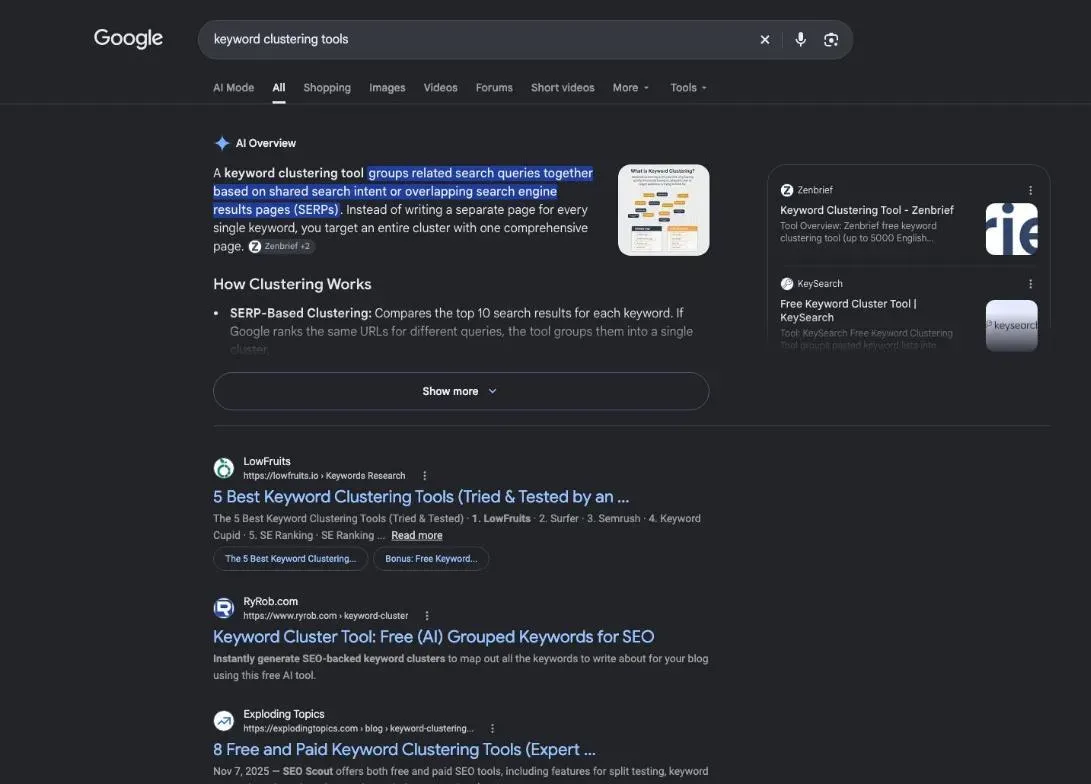
A cluster is a group. Keyword clustering means putting together the searches that expect the same answer. “Schedule Instagram posts” and “Instagram scheduler” usually come from the same person with the same problem.
Clusters based on Google results, or on word meaning
There are two ways to build those groups.
The first looks at what Google shows. If Google returns the same pages for two searches, it treats them as one topic, and one page can target both. If it returns different pages, write two pages. That’s the rule this site uses for its own pages: two keywords go together when their results share URLs.
| Same group | Two groups | |
|---|---|---|
| What Google shows | the same pages for both searches | different pages for each search |
| What you write | one page that targets both | one page per search |
The second groups words by meaning: synonyms, shared terms, close phrasing. It’s faster, but two phrases can look alike and still lead to different results.
How many keywords belong in one cluster
There’s no fixed number. A cluster holds as many keywords as Google treats as the same topic: two for a narrow question, a dozen for a broad need. In my test, SemChat’s first group held ten unbranded keywords.
The useful question isn’t “how many?” but “would one page answer all of these?” If not, split the group.
How keyword clustering software works
Most tools follow the same three moves. They take your list, with a monthly search volume for each keyword. They compare the keywords, either through Google’s results or through word meaning. Then they hand back groups, often with a suggested main keyword per group.
The differences sit in the details: where the volumes come from, whether difficulty is measured on Google’s organic results or on ad prices, and whether the tool checks the pages you already have. SemChat’s test shows why each one matters.
Why group your keywords before you write
Without groups, you may write three pages that fight for the same search. Or miss the question your customers ask most.
One page per group, not one page per keyword
Each group gets one page, with one main keyword. The other keywords in the group become subheadings, FAQ questions or sentences in the text.
Example: a candle shop doesn’t write one page for “natural scented candle” and another for “scented natural candle.” One page answers both, and answers better. And before you group, you need the search volume of each keyword: it’s the number every tool shows first, and the one that varies most.
Step 1: ask SemChat for the clusters, with precise instructions
SemChat is an SEO assistant you talk to: you type a sentence, it runs its tools, then it answers. In France, its data comes from Haloscan, according to an email from Haloscan dated October 29, 2026.
No keyword research skill: go through clustering
The home screen offers three shortcut cards under the text box. One is called “Recherche de mots-clés” (keyword research), with the words “Volume, difficulté, intention.” (volume, difficulty, intent).
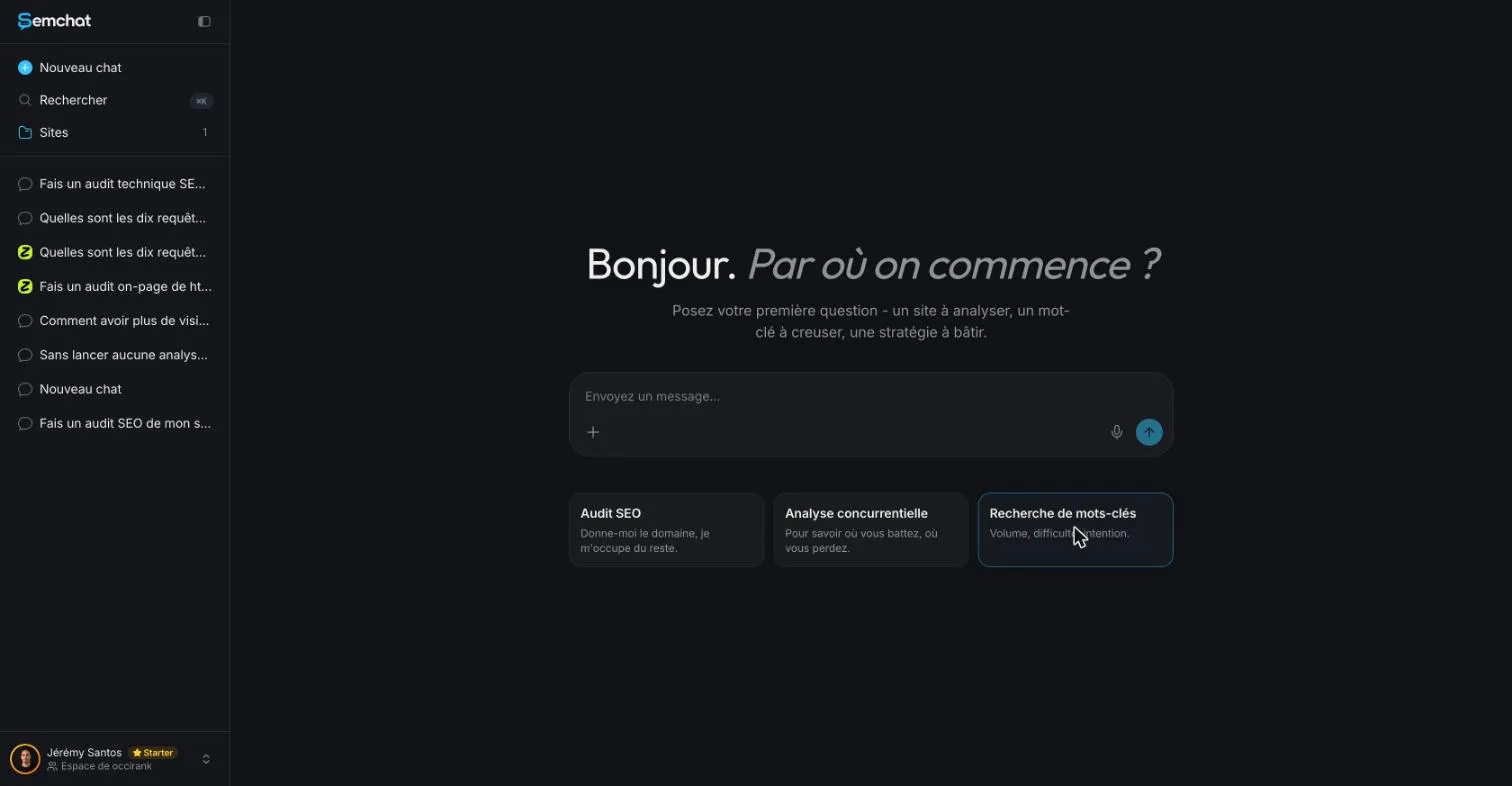
I clicked it first. It inserts a ready-made sentence asking for the best keywords to target in the sector. The result was weak: its first keyword ideas returned nothing, and 15 of the 20 keywords it kept were brand names (Metricool, Buffer, Hootsuite and others).
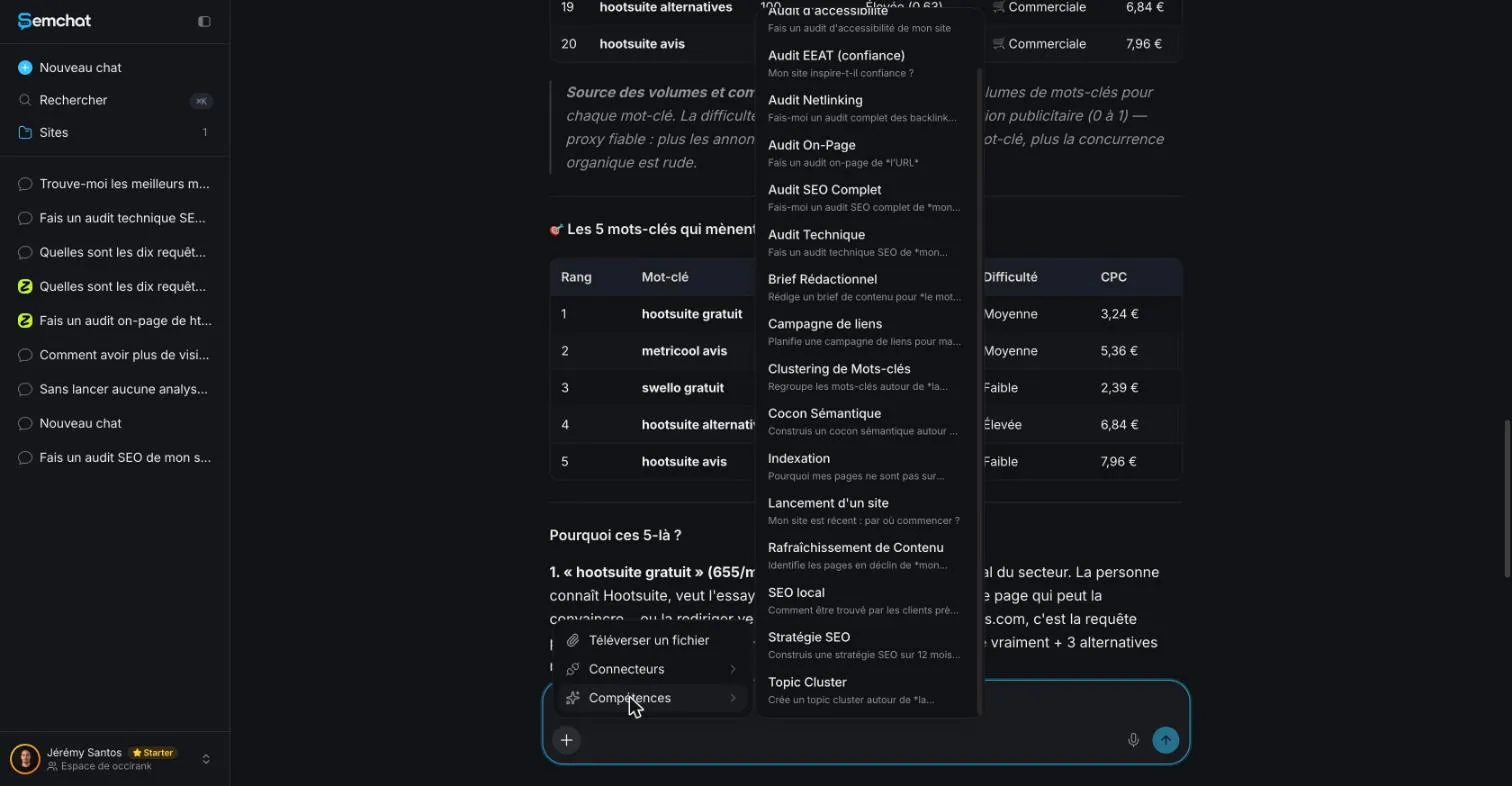
Here’s the catch: the Skills menu, under the “+” button, has no keyword research skill. Only the card carries that name. The skill that groups keywords is called “Clustering de Mots-clés” (keyword clustering).
The three points to correct in your request, as we typed them in French
The first table had another flaw. SemChat said its “difficulty” came from the ad competition score and called it a reliable proxy. But what advertisers pay doesn’t tell you whether you can rank in Google’s organic results.
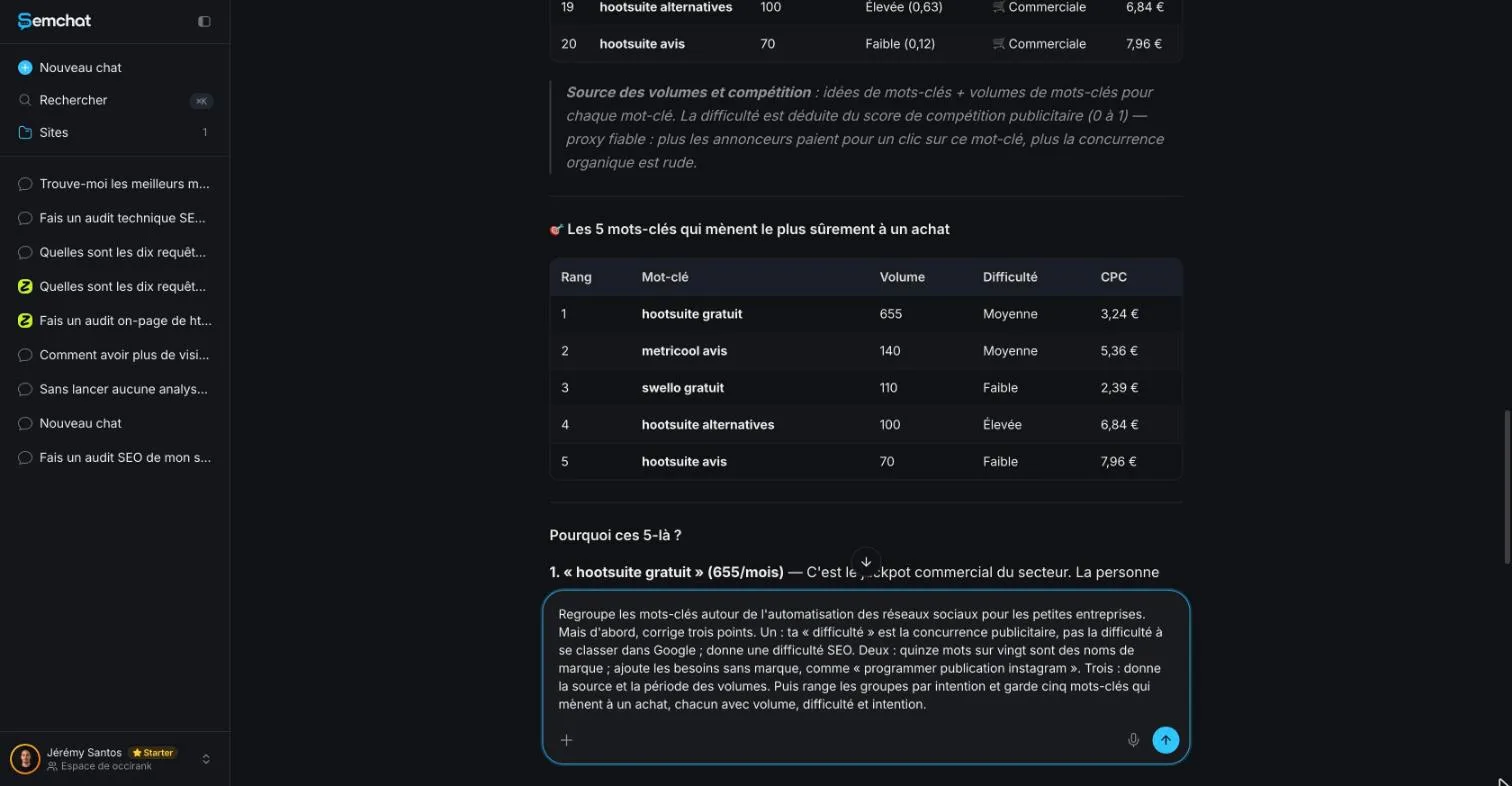
So I followed up with the clustering skill and named the three flaws. The test ran in French, on a French site, with the interface in French. Here is the request as typed:
« Regroupe les mots-clés autour de l’automatisation des réseaux sociaux pour les petites entreprises. Mais d’abord, corrige trois points. Un : ta « difficulté » est la concurrence publicitaire, pas la difficulté à se classer dans Google ; donne une difficulté SEO. Deux : quinze mots sur vingt sont des noms de marque ; ajoute les besoins sans marque, comme « programmer publication instagram ». Trois : donne la source et la période des volumes. Puis range les groupes par intention et garde cinq mots-clés qui mènent à un achat, chacun avec volume, difficulté et intention. »
In English: group the keywords around social media automation for small businesses; first, fix three points. One, your “difficulty” is ad competition, not how hard it is to rank in Google, so give an SEO difficulty. Two, fifteen of twenty keywords are brand names, so add unbranded needs such as scheduling an Instagram post. Three, give the source and the period of the volumes. Then sort the groups by intent and keep five keywords that lead to a purchase, each with volume, difficulty and intent.
How the same request performs in English is missing data: an English test is planned. Copy the structure, not the words: your topic, the flaws you see, the output you want.
Step 2: read the groups it returns, by intent
The answer opened with “Tu as raison sur les trois points” (you’re right on all three points). Then SemChat ran its keyword tools again and returned a corrected analysis.
Unbranded needs first, then brands ready to buy
Two groups. The first held ten concrete needs with no brand name, such as scheduling an Instagram post or an Instagram planner. The person wants a solution, not a specific tool.
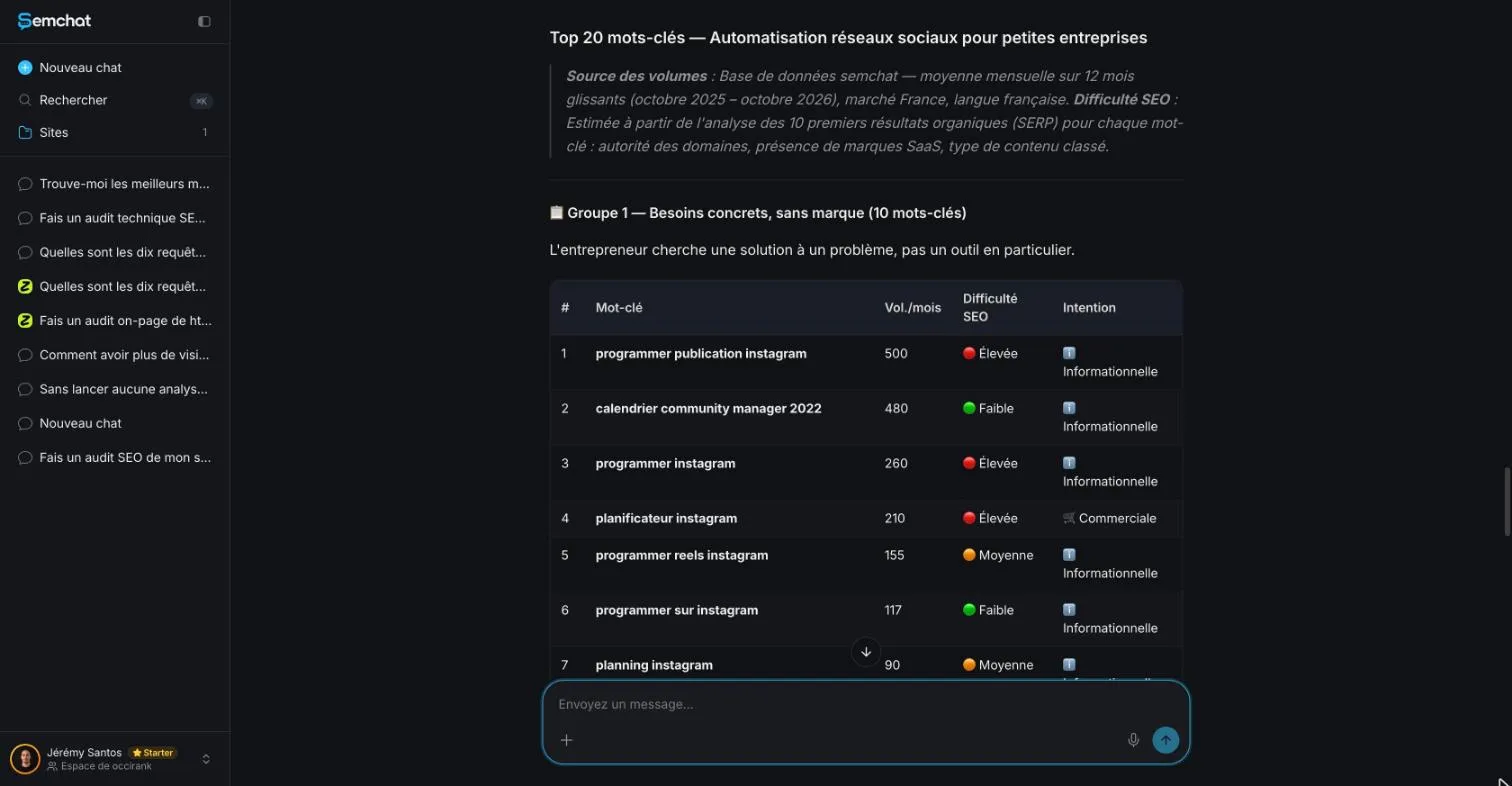
The second held brands with buying intent. It kept five, all labeled commercial: searches for a free Hootsuite, Metricool reviews, a free Swello, a free Metricool and Hootsuite alternatives. Each came with a volume, a difficulty and a reason.
For a site that earns from sales or affiliate links, some words signal a purchase: review, price, free, alternative, comparison, best. That’s the grid I used here.
Difficulty estimated from Google’s first results
Difficulty no longer came from ads. This time SemChat estimated it from the top 10 organic results of each keyword: domain authority, presence of brands, type of content ranking.
That’s better. But difficulty stays an estimate specific to each tool. For “programmer publication instagram” (schedule an Instagram post), SemChat gave a score of 76 out of 100; DataForSEO Labs gave 0 the same day.
Where the volumes come from, given after a follow-up
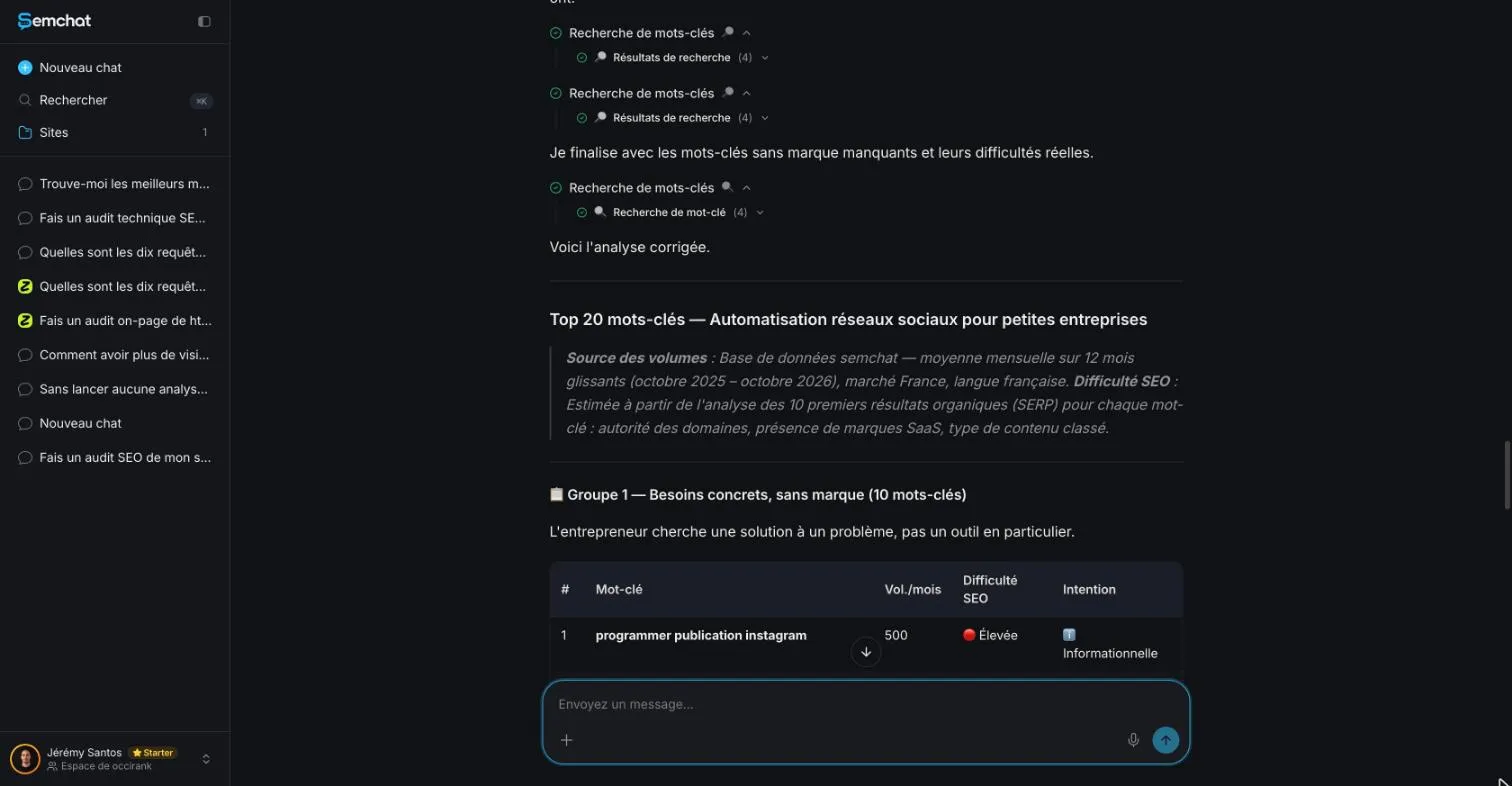
Before I asked, SemChat didn’t say where its volumes came from. After the follow-up, it wrote it above the table: “Base de données semchat, moyenne mensuelle sur 12 mois glissants (octobre 2025 à octobre 2026), marché France” (SemChat database, monthly average over a rolling 12 months, October 2025 to October 2026, French market). Quoted without the dash from its answer.
10% off your subscription, for life with my link, if you subscribe within 2 weeks of signing up. No code. All about the SemChat promo code
Try SemChat for free Free plan, no credit card. Affiliate link: it costs you nothing extra.
Step 3: correct the groups before using them
The groups made sense. The numbers, much less. Here’s what I checked the same day.
Volumes far from other sources
I compared SemChat’s volumes with Google Ads volumes, pulled through DataForSEO (France, French, October 29, 2026). Out of four keywords, one matched.
| SemChat | Google Ads (DataForSEO) | |
|---|---|---|
| hootsuite gratuit | 655 | 140 |
| swello gratuit | 110 | 20 |
| hootsuite alternatives | 100 | 50 |
| metricool avis | 140 | 140 |
The top keyword on its list, a free Hootsuite, drops from 655 searches a month to 140. Build a page on the first number and you’d expect more than four times the visits. Check every SemChat volume against a second source before you use it.
A dated keyword to drop
Second in the unbranded group: “calendrier community manager 2022” (community manager calendar 2022), at 480 searches a month according to SemChat. A search with a past year in it draws people looking for something other than a page written in 2026. Drop it, or use the version without the year.
Suggested pages that already exist
SemChat ended with three actions, including a Metricool review page and an article on Hootsuite’s free version. My site already had pages on those topics: its Hootsuite alternatives page and its Metricool pricing page both returned a 200 status on October 29, 2026. In Search Console, the French search for a Hootsuite alternative already showed the first one (average position 79, 1 impression, October 2026).
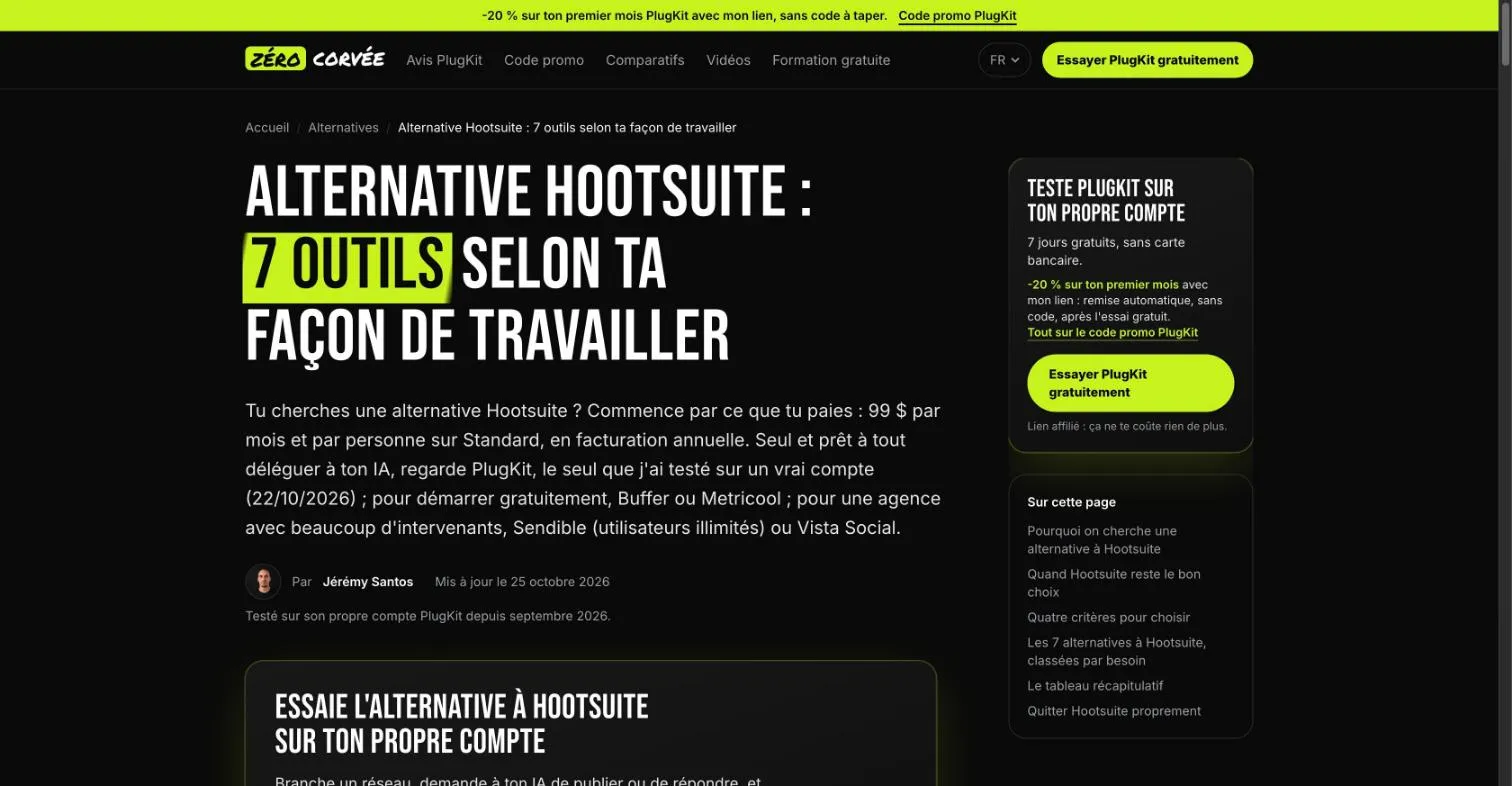
Before creating a page, look for the one that already targets the keyword. Often, improving it beats starting over: see our guide on how to update old blog posts.
Step 4: turn the groups into a pillar page and its articles
A broad group, like scheduling Instagram posts, deserves a main page. The narrower searches in the same group (scheduling a reel, an Instagram planner) become supporting articles linked to it. That structure is a topic cluster, and SemChat has a separate skill for it, covered on our topic cluster tool page.
Then two jobs remain. Prepare each page with a brief: the reader’s question, the pages to beat, the sources; our content brief generator page shows SemChat’s version. Then link the pages to each other, with the internal linking tools that page compares.
The keyword cluster tools most lists name
SemChat is one option among many. Here’s what the pages ranking for this search say, and what each tool’s own pages say. None of these tools was tested on this site.
SE Ranking and Keyword Cupid, named on both lists
Two of the top-ranking lists on October 29, 2026, from Contentellect and from eesel, both name SE Ranking and Keyword Cupid among their keyword grouping tools.
- SE Ranking: its Keyword Grouper groups keywords by shared URLs in Google’s results, the same principle as the diagram above, and pitches it as a way to “Plan the SEO architecture of your future website.” Its help center lists it among tools paid from the account balance (SE Ranking profile, October 29, 2026).
- Keyword Cupid: this site has no dated profile of it, so nothing more is said here.
Other suites list clustering among their features, according to their own pages:
- Ahrefs: Keywords Explorer promises to “Instantly cluster keywords by Parent Topic or related terms”; keyword clusters start with the Standard plan (Ahrefs profile, October 29, 2026).
- Moz: Keyword Explorer offers to “Group keywords by lexical similarity” (Moz profile, October 30, 2026).
- Similarweb: its AI SEO Strategist agent “clusters keywords by intent and value” (Similarweb profile, October 30, 2026).
Free keyword clustering tools: what they can handle
Free options exist, but their limits change often, and this site doesn’t quote a free limit without reading the tool’s own page.
- SemChat: Free plan at €0; the pricing page says “Every feature, in every plan.” (read October 30, 2026). The clustering skill is included. The quota my test used is missing data: the measurement covers two lessons, 22.4 points of the Starter plan’s monthly quota for indexing and clustering together (October 29, 2026).
- Quattr: a page titled “Free Keyword Clustering Tool” ranked in the top 10 on October 29, 2026. Not tested.
- Keysearch, ContentGecko and Zenbrief: cited as sources by Google’s AI Overview for this search on October 29, 2026. Not tested, no profile on this site.
The full test of SemChat is in our SemChat review, and its plans are on our SemChat pricing page.
My verdict on SemChat among keyword clustering tools: a good sorter that groups by intent and corrects itself when you point out its mistakes. Not an oracle: its volumes drift from Google Ads, it keeps dated keywords, and it suggests pages you already have. Give it precise instructions, then check three things before you write: the volume, the year, and your own site.
Frequently asked questions
Do you need a keyword clustering tool at all?
Not for a short list. With 20 keywords, you can search each one in Google, note the top results, and group the searches that share pages. A tool saves time once the list runs into the hundreds, but its groups and volumes still need a check before you write.
Is there a free keyword cluster tool worth trying?
SemChat has a Free plan at €0, and its pricing page says “Every feature, in every plan.” (read October 30, 2026), so the clustering skill is included. Other tools advertise free clustering pages, but this site hasn't tested them and doesn't quote their free limits without reading their own pages.
What does a keyword clustering example look like?
In my test, SemChat built two groups for social media scheduling tools: unbranded needs such as scheduling an Instagram post, then brand searches close to a purchase, such as a free version of Hootsuite or reviews of Metricool. Each group becomes one page, with one main keyword and the others as subheadings.
Does SemChat's keyword clustering work in English?
My test was run in French, on a French site, with the interface in French. An English test is still missing data (planned in a later test). For markets outside France, SemChat's data comes from a mix of unnamed providers, according to an email from Haloscan dated October 29, 2026.
Let your AI do the chores of getting found online.
10% off your subscription, for life with my link, if you subscribe within 2 weeks of signing up. No code. All about the SemChat promo code
Affiliate link: it costs you nothing extra.