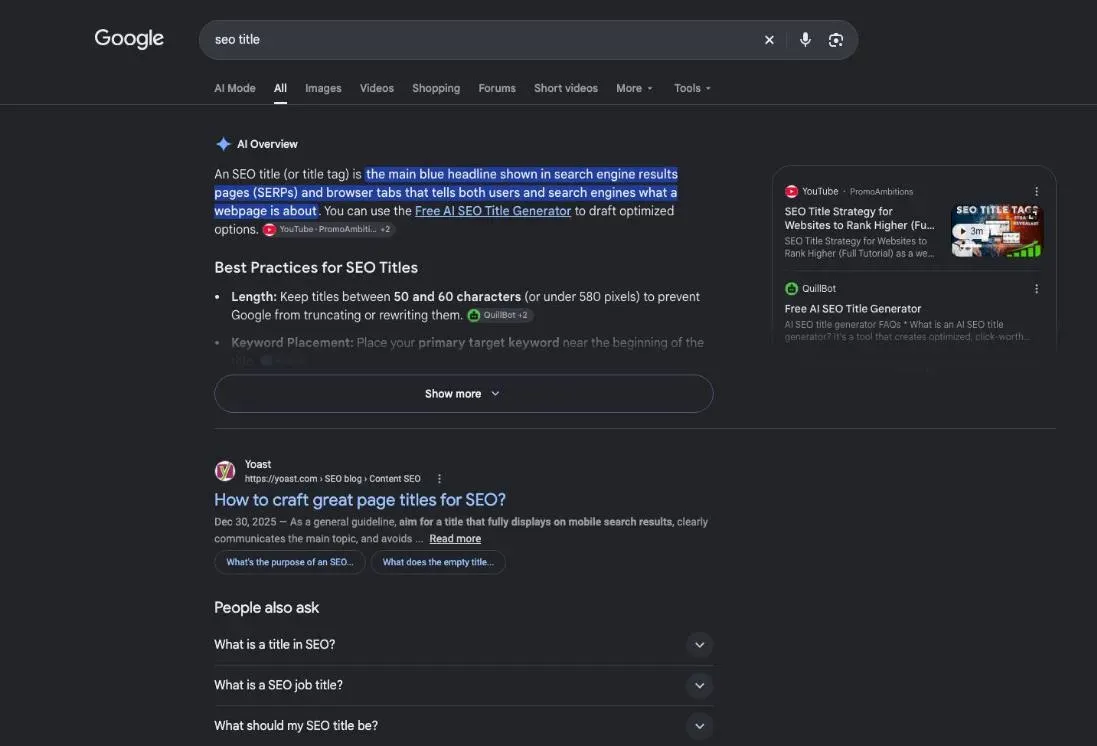
SEO title: write the title Google shows, and avoid duplicates
Your SEO title is the title of your page, written in its code. Google uses it first to build the blue headline of your search result, the one people click. Here's how to write it in five steps, what Google does when it rewrites it, and the duplicate trap I found on a real site, based on Google's documentation read on 30 October 2026.
 By Jérémy Santos Updated on 30 October 2026 Tested on his own SemChat account: first audit on 29 October 2026.
This page is part of the guide: website optimisation

The title Google shows is the first thing your customer reads. Illustration by Zéro Corvée.
On Google, people read your title before they read your page. One blue line, a few words. If it’s vague, they click somewhere else. Your SEO title decides much of what that line says.
This page shows you how to write it, step by step, using Google’s documentation and real titles from my other site. The other page settings (text, images, links) are on our website optimisation page. The SemChat buttons on this page are affiliate links.
SEO title: the title Google shows in its results
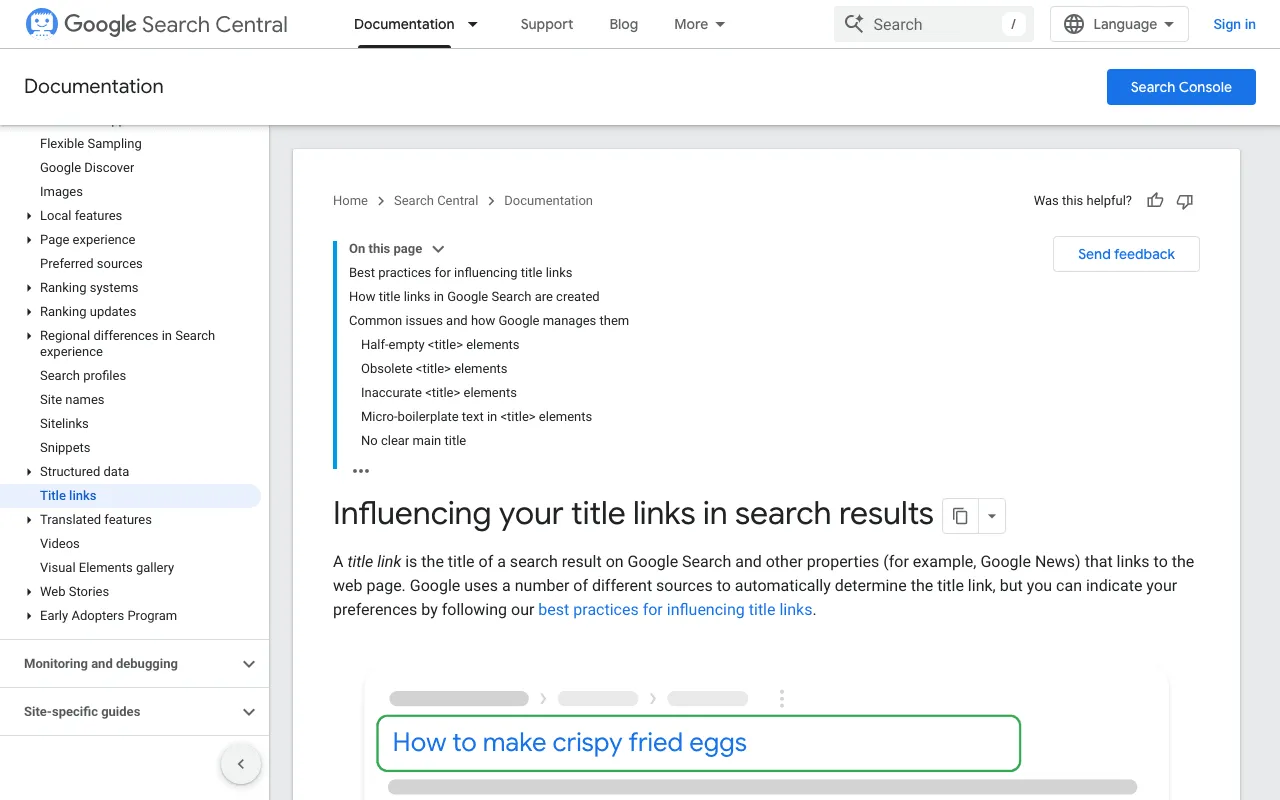
Google calls that blue headline a title link: “A title link is the title of a search result on Google Search and other properties (for example, Google News) that links to the web page.” Google builds it automatically, and the first source on its list is your title tag. Its stated aim: “The goal of the title link is to best represent and describe each result” (title link documentation, read 30 October 2026).
This page targets “seo title,” searched about 1,300 times a month in the US (DataForSEO, 29 October 2026).
SEO title tag, page title, meta title: one element
SEO title tag, page title, meta title: different names, one thing. In your page code it looks like this: <title>Fig-scented candle, amber jar | Lune Studio</title>. You write it once, and it shows up in three places.
- Title tag written once
- Page code in the head of the HTML
- Browser tab the name at the top of the tab
- Google results often used as the blue headline
You don’t need to touch code. Google notes: “Most CMSes can automatically turn the titles you write into a <title> element in the HTML” (SEO Starter Guide, read 30 October 2026).
The title tag and the main heading: the difference
The title tag names the page for Google and the browser tab. The H1 is the big heading readers see at the top of the text. They can differ slightly, but they should make the same promise. Right after the title tag, Google’s source list names the “Main visual title shown on the page” and “Heading elements, such as <h1> elements.”
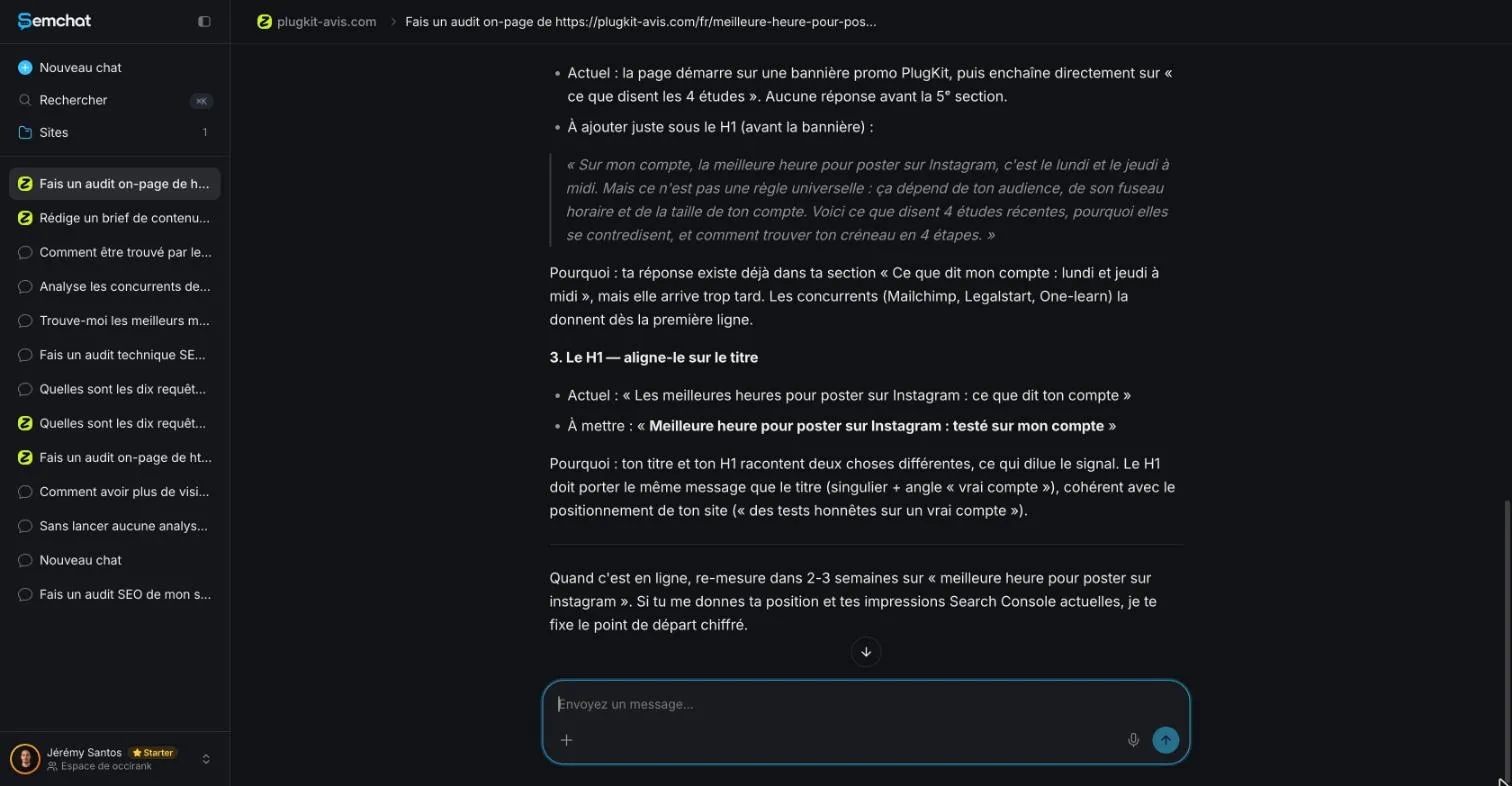
A real case: on 29 October 2026, SemChat’s on-page audit found this title tag on a plugkit-avis.com page: “Meilleures heures pour poster sur Instagram : 4 études” (Best times to post on Instagram: 4 studies). The H1 said “Les meilleures heures pour poster sur Instagram : ce que dit ton compte” (The best times to post on Instagram: what your account says). Studies on one side, your own account on the other: two promises for one page. I checked; it was right.
Why your SEO title matters
Two reasons. First, it helps Google understand the page: it’s the first source on Google’s list. Second, it wins or loses the click. Google says the title link is “often the primary piece of information people use to decide which result to click, so it’s important to use high-quality title text on your web pages.”
A title is one setting among several. The full list of page settings is on our page about what is on-page SEO.
How to write an SEO title, step by step
Take an online candle shop, Lune Studio, and its product page for a fig-scented candle.
Step 1: start from what the searcher wants
Write for the person typing the search, not for your catalogue. Someone looking for this candle types something like “fig scented candle.” Your title should answer that search in plain words.
Step 2: put one main keyword first
Put that main keyword at the start. It’s what the eye looks for in a list of results, and what stays visible if the end gets cut. This is the rule this site follows; Google’s documentation doesn’t ask for a position.
One keyword is enough. Google: “Avoid keyword stuffing.” A title like “Scented candles, candles, best candles, cheap candles” helps no one, and Google warns that this kind of stuffing “can make your results look spammy to Google and to users.”
Step 3: add a word that earns the click, only if needed
Google asks for “descriptive and concise text” and warns against vague words like “Home” or “Profile.” Describe the page first. Then, if there’s room, add the one detail that makes your result the better choice: hand-poured, tested, price included. Only if it’s true.
Step 4: write blog titles and sales page titles differently
A sales page names the thing: “Fig-scented candle, amber jar | Lune Studio.” A blog post answers a question: “How long does a candle burn? We timed ours.” Same rule for both: the title has to match what the page delivers.
Step 5: keep it short enough to show in full
How long should an SEO title be? Google gives no number: “While there’s no limit on how long a <title> element can be, the title link is truncated in Google Search results as needed, typically to fit the device width.” It also says to “avoid unnecessarily long or verbose text.”
This site caps every title at 60 characters, spaces included. That’s our rule, not Google’s: it keeps the meaning readable even when the end gets cut. The title of this page, “SEO Title: Write the Title Google Shows in Results,” is 50 characters (counted 30 October 2026). How long titles and descriptions show in search results is covered on our meta description length page.
10% off your subscription, for life with my link, if you subscribe within 2 weeks of signing up. No code. All about the SemChat promo code
Try SemChat for free Free plan, no credit card. Affiliate link: it costs you nothing extra.
SEO title examples: weak, better, best
On 29 October 2026, I asked SemChat for an on-page audit of the plugkit-avis.com home page, launched from the “+” menu of the message bar. It proposed three titles, each with the part of my page or brief it came from.
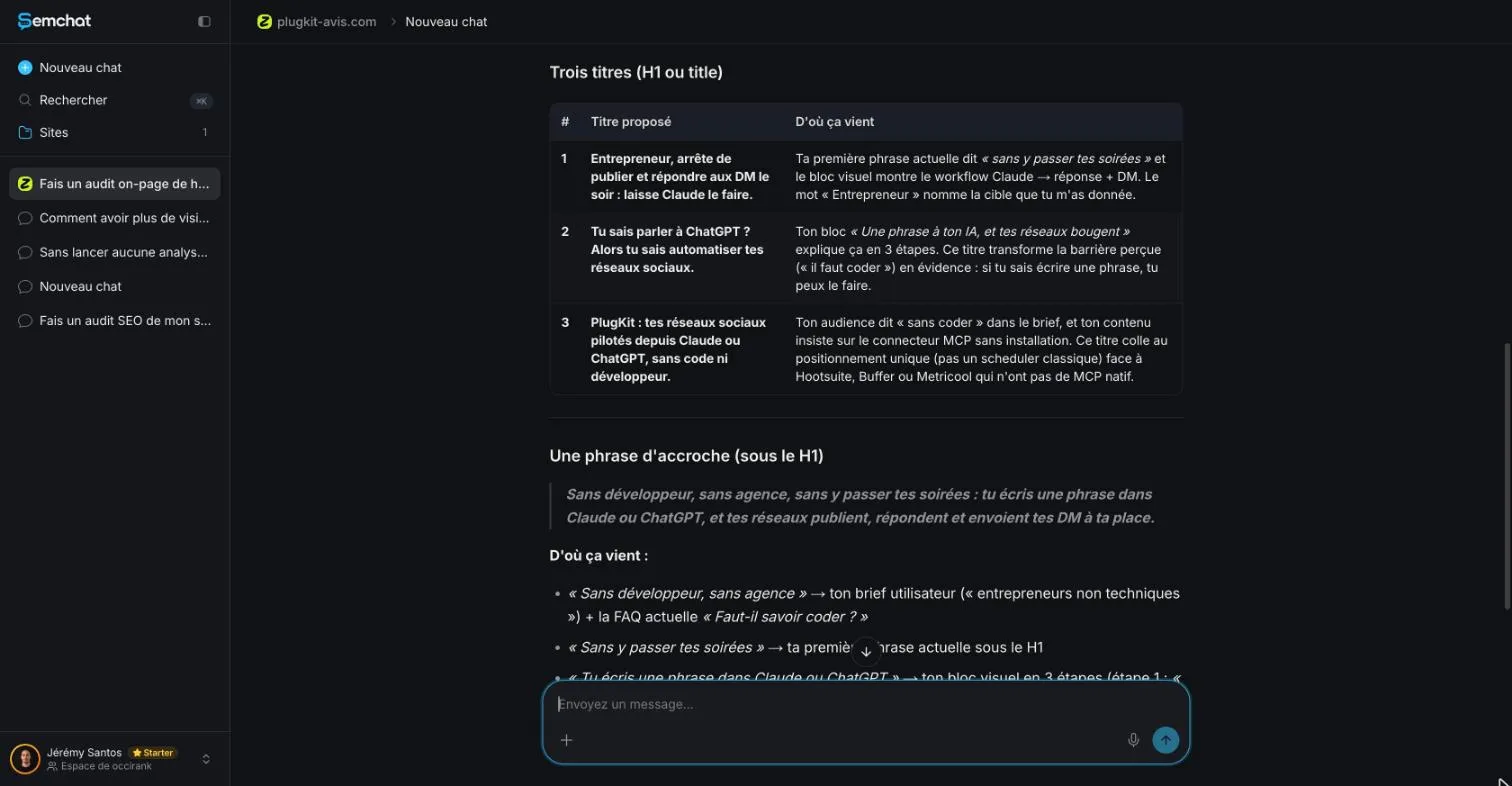
The good part: each idea has a source, so you can check where it came from. The problem: the three French titles run 84, 73 and 89 characters, far past this site’s 60. Good hooks for a main heading, too long for a title tag as written.
Here’s the same logic applied to the candle shop:
- Weak: “Home.” Google names this exact word as a vague descriptor to avoid.
- Better: “Scented candles.” Clear, but it could be any shop’s page.
- Best: “Lune Studio: hand-poured scented candles in Austin.” 50 characters (counted 30 October 2026): the brand, what it sells, where.
Title tag best practices in one checklist
From Google’s documentation, plus this site’s own rule:
- Every page has a title tag.
- Each title is distinct from the others.
- It describes the page in a few words.
- No keyword repeated over and over.
- The main keyword comes first (this site’s rule).
- The brand sits at the start or the end, after a separator.
- The main heading makes the same promise.
- Same language as the page text.
Home page, product page and blog post titles
Google’s advice: “Brand your titles concisely.” Your home page is “a reasonable place to include some additional information about your site.” On inner pages, add just your site name at the beginning or end, separated by “a delimiter such as a hyphen, colon, or pipe.” Product pages name the product; blog posts name the question they answer.
Add or change your SEO title in WordPress
On WordPress, you usually set the title tag with an SEO plugin. According to their product sheets, several do it in their free version: Rank Math (29 October 2026), AIOSEO Lite, which “covers the fundamentals: title tags, meta descriptions, and basic sitemaps” (29 October 2026), Yoast SEO (30 October 2026) and SEOPress (30 October 2026). You write the SEO title page by page in the field provided. Leave it empty, and your tool picks the title for you: check what ends up in the tag.
SemChat lists WordPress among its connectors (app review, 29 October 2026). I haven’t tested whether it can change a title through it, so I won’t promise that.
Title generators and checkers: use them with care
An AI tool, SemChat included, can suggest ten titles in seconds. That’s handy for ideas. But the three titles above show the limit: none would fit this site’s length rule. Count the characters yourself and check that the title matches the page before you use it.
When Google rewrites your title, and when to fix it
Sometimes the blue headline isn’t your title tag. Google picks from several sources, including the H1, other prominent text on the page, the anchor text of links pointing to the page and WebSite structured data. That last group matters: the words other sites use to link to you count too. You can see them when you check backlinks, and judge them with a link audit.
Google usually swaps a title when it spots one of these issues:
- half-empty, like
<title>| Site Name</title>; - obsolete: “2020 admissions criteria” while the page’s big heading says 2021;
- inaccurate: the title doesn’t reflect what the page is about;
- micro-boilerplate: the same text on several pages, missing what sets them apart;
- no clear main title: Google “may use the first heading as the text for the title link”;
- language mismatch between the title and the page text.
Fix the issue on your page, then wait: Google has to recrawl it, which “may take a few days to a few weeks.” Don’t ask Google to change it by hand: “we can’t manually change title links for individual sites.” And if your title has none of these issues, Google suggests asking whether its version is a better fit for the query.
Duplicate titles: the mistake found on a real site
On 29 October 2026, I asked SemChat for a full audit of plugkit-avis.com, my other affiliate site, in five languages. Its diagnosis: duplicate titles on 100 pages (53%) and duplicate H1s on 102 pages (54%), caused by the language versions.
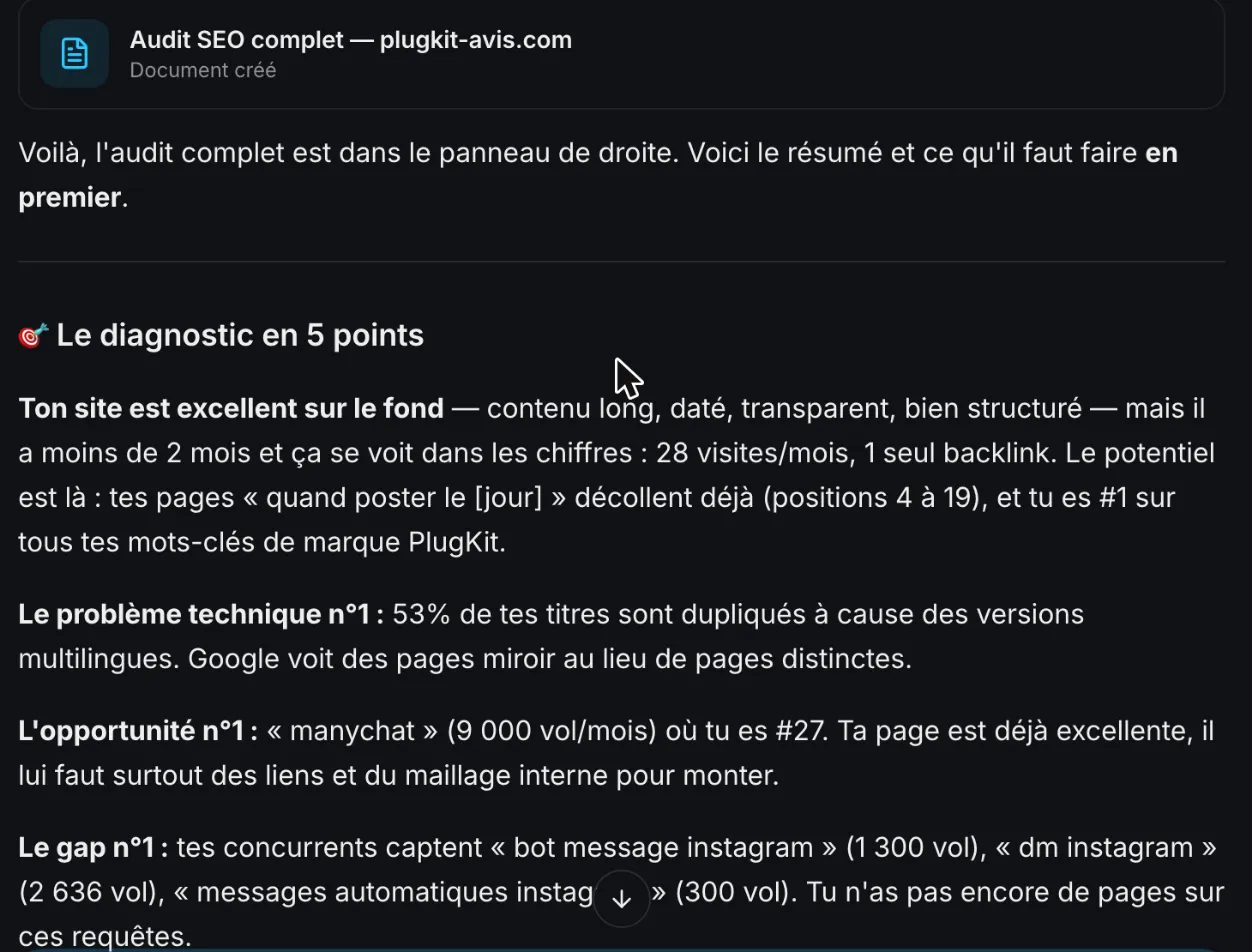
I checked with curl that day. The US English review page and its UK English version did share the same title tag. But they’re declared to Google as variants of each other (hreflang tags), so SemChat’s “pages miroir” (mirror pages) went too far. The flag was still useful.
On 30 October 2026, I pulled the title tag and H1 of all 194 URLs in the plugkit-avis.com sitemaps. Only one title tag is still shared, between the site root and the French home page; the UK review page now has “UK” in its title. The H1s are still identical on 104 pages, 100 of them in US and UK pairs.
Google gives a close example, a TV show site:
Three pages, one title tag
- My so-called amazing TV show
- My so-called amazing TV show
- My so-called amazing TV show
What Google may show
- Season 1 - My so-called amazing TV show
- Season 2 - My so-called amazing TV show
- Season 3 - My so-called amazing TV show
The title rule this site follows
Each page gets one keyword and one title, set before writing. A topic cluster gives every page its own subject, so its own title, and a content brief fixes the keyword and title of each page up front. Then the page has to keep the promise: that’s SEO content writing, held together by internal linking SEO, and backed by trust, which Google ranks first among its quality aspects (see EEAT meaning).
My full test of SemChat is in our SemChat review, and its plans are on our SemChat pricing page.
The short version for your SEO title: one per page, distinct from the others, describing the page, keyword first, brand last if it fits. Start with your most visited pages, fix them, and check what Google shows a few weeks later.
Frequently asked questions
What should your SEO title be?
A short, accurate description of the page, unique to it, with the main keyword near the start and your brand at the end if it fits. Google asks for “descriptive and concise text” in the title element and warns against vague titles like “Home” (title link documentation, read 30 October 2026).
How long should a blog title be for SEO?
Google sets no number: “While there's no limit on how long a <title> element can be, the title link is truncated in Google Search results as needed, typically to fit the device width” (read 30 October 2026). This site caps its own titles at 60 characters with the keyword first, so the meaning survives a cut. That's our rule, not Google's.
Do SEO titles still matter in 2026?
Yes. Google lists the content of the title element first among the sources it uses to build title links, and says the title link is “often the primary piece of information people use to decide which result to click” (title link documentation, read 30 October 2026).
What are heading tags in SEO?
Heading tags (H1 to H6) are the titles inside your page text: the H1 is the main heading, H2s and H3s split the sections. They're different from the title tag, which names the page for Google and the browser tab. Google asks you to make the main title clear, for example with the first visible H1.
Let your AI do the chores of getting found online.
10% off your subscription, for life with my link, if you subscribe within 2 weeks of signing up. No code. All about the SemChat promo code
Affiliate link: it costs you nothing extra.
Verified sources
- Google Search Central: Influencing your title links in search results (30/10/2026)
- Google Search Central: SEO Starter Guide (30/10/2026)
- Google Search Central: Control your snippets in search results (meta description) (30/10/2026)
- SemChat pricing (Free plan, every feature in every plan) (29/10/2026)