SEO keywords examples: lists by business type, and how to build yours
Good SEO keywords examples are the exact words your customers type: "custom birthday cakes", "when to plant garlic", "soy candles". Below you'll find real lists for a local shop, a blog and an online store, each with its measured US search volume, then a four-step method to build your own.
 By Jérémy Santos Updated on October 30, 2026 Tested on his own SemChat account: first audit on October 29, 2026.
This page is part of the guide: Keyword research tool
You know you need keywords, but a blank page doesn’t tell you which ones. The fastest way in is to look at real SEO keywords examples, then copy the method behind them. This page is part of our keyword research tool guide: here we build the list by hand, then let an assistant group it by page.
One note on links: only the SemChat and Haloscan links are affiliate links. They don’t change prices or the order of the tools.
- 1 Brainstorm The words your customers use.
- 2 Expand Google and a keyword generator.
- 3 Check the numbers Volume and competition.
- 4 One page per need Group, then write.
SEO keywords examples: what a keyword looks like
A keyword isn’t a single magic word. It’s the full phrase a person types: “custom birthday cakes”, “how to grow tomatoes”, “best smelling candles”. Each one tells you two things: the topic, and what the person wants to do next.
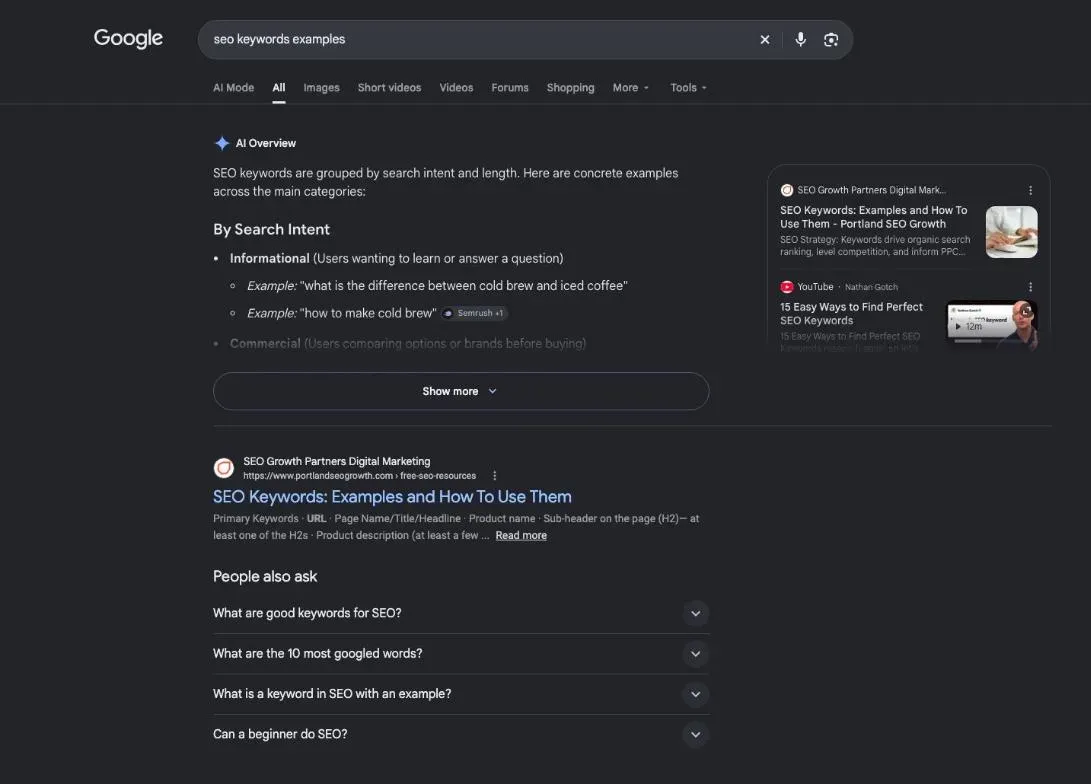
Why keywords still matter to Google
Google’s SEO Starter Guide puts it plainly: “Think about the words that a user might search for to find a piece of your content” (read October 30, 2026). If your page says “artisan confectionery” and your customers type “custom cakes”, you’re speaking a different language from your buyers.
Keywords also help you decide what to write first. A search close to a purchase is worth more to a small business than a curiosity.
Short-tail and long-tail keyword examples
Every keyword sits somewhere between short and broad, and long and precise.
| Short-tail | Long-tail | |
|---|---|---|
| Looks like | one or two words | three words or more |
| Who types it | everyone, for many reasons | people who know what they want |
| Competition | big brands and directories | fewer pages aim at it |
| Best use | a category or home page | one focused page each |
Broad, short searches that everyone wants
“Soy candles” was searched about 18,100 times a month in the United States (DataForSEO Google Ads, October 30, 2026). That’s a big audience, but you’ll compete with marketplaces and big retailers, and you can’t tell whether the person wants to buy, compare or learn.
Longer searches that are easier to win
“How much does a custom cake cost” gets about 140 searches a month (same source and date). Small, but the person is close to ordering. A short page that answers with real prices can rank for it and bring a customer.
Keyword examples sorted by what the searcher wants
The same topic can hide very different needs. Sort your examples by intent before anything else. Our guide to keyword intent goes deeper.
Keywords that look for information
“How to grow tomatoes”, “when to plant garlic”, “how to make candles”. The person wants to learn. A guide or a tutorial fits; a product page doesn’t.
Keywords that compare or buy
“Best fertilizer for tomatoes”, “best smelling candles”, “custom birthday cakes”. Words like best, price, review, custom or order signal that money is close. These deserve your most careful pages.
Keywords that look for a brand or a place
“Bakery near me” or a brand name. The person already knows where they want to go. For a local shop, “near me” searches are the ones to watch first.
Keyword lists by type of business
Every volume below is the average monthly search volume in the United States, measured with DataForSEO Google Ads on October 30, 2026. Volumes are rounded by Google, so read them as orders of magnitude.
Keyword examples for a local shop
A bakery, for example:
| Keyword | Monthly searches (US) | What the person wants |
|---|---|---|
| bakery near me | 3,350,000 | find a place now |
| gluten free bakery near me | 74,000 | find a place with a specific offer |
| custom birthday cakes | 4,400 | order |
| how much does a custom cake cost | 140 | check the price before ordering |
The huge “near me” number is shared by every bakery in the country. Your real chance is the specific ones: “gluten free”, “custom”, the price question.
Keyword ideas for a blog
A gardening blog:
| Keyword | Monthly searches (US) | What the person wants |
|---|---|---|
| how to grow tomatoes | 12,100 | learn |
| best fertilizer for tomatoes | 8,100 | compare, then buy |
| when to plant garlic | 6,600 | a quick answer |
Watch the season. “How to grow tomatoes” swung from 4,400 searches in December 2025 to 27,100 in May 2026 in the same data. Publish before the peak, not during it.
Keyword ideas for an online store
A candle shop:
| Keyword | Monthly searches (US) | What the person wants |
|---|---|---|
| soy candles | 18,100 | browse, maybe buy |
| how to make candles | 12,100 | learn (and maybe buy supplies) |
| best smelling candles | 2,900 | compare before buying |
“Soy candles” climbed to 40,500 searches in November and December 2025: gift season. A store plans its pages around that curve.
Main, secondary and competitive keywords
Once you have a list, each page needs a clear job.
One main keyword, a few secondary ones
Give every page one main keyword, the need it answers, and a few close variations. “Custom birthday cakes” can carry “custom cake prices” and “order a birthday cake” on the same page. Two pages chasing the same need compete with each other.
Related words that help Google understand the page
Many tools sell “LSI keywords”. It’s a label from tools and blogs, not a method Google describes in any page we read. The useful idea behind it is simple: a page about tomatoes that never mentions soil, sun or watering looks thin. Cover the topic, and the related words come on their own.
How much competition each keyword faces
Some tools show a keyword difficulty score. Google Keyword Planner shows a competition level (low, medium or high) that, according to Google’s own Keyword Planner page (French version, read October 30, 2026), reflects the number of advertisers bidding: it is about ads, not organic results. The honest check is to search the keyword yourself and look at who ranks. Our guide on how to choose keywords for SEO explains how to judge it.
Build your own keyword list, step by step
Step 1: brainstorm the words your customers use
Spend twenty minutes writing down every question customers ask you by email, on the phone or at the counter. Keep their exact words, typos included. That’s what they type into Google.
Step 2: expand the list with a keyword generator
Type each idea into Google and note the autocomplete suggestions, the “People also ask” questions and the related searches. Then use a generator. Ahrefs’ free Keyword Generator shows the first 100 ideas without an account (Ahrefs fact sheet, October 29, 2026).
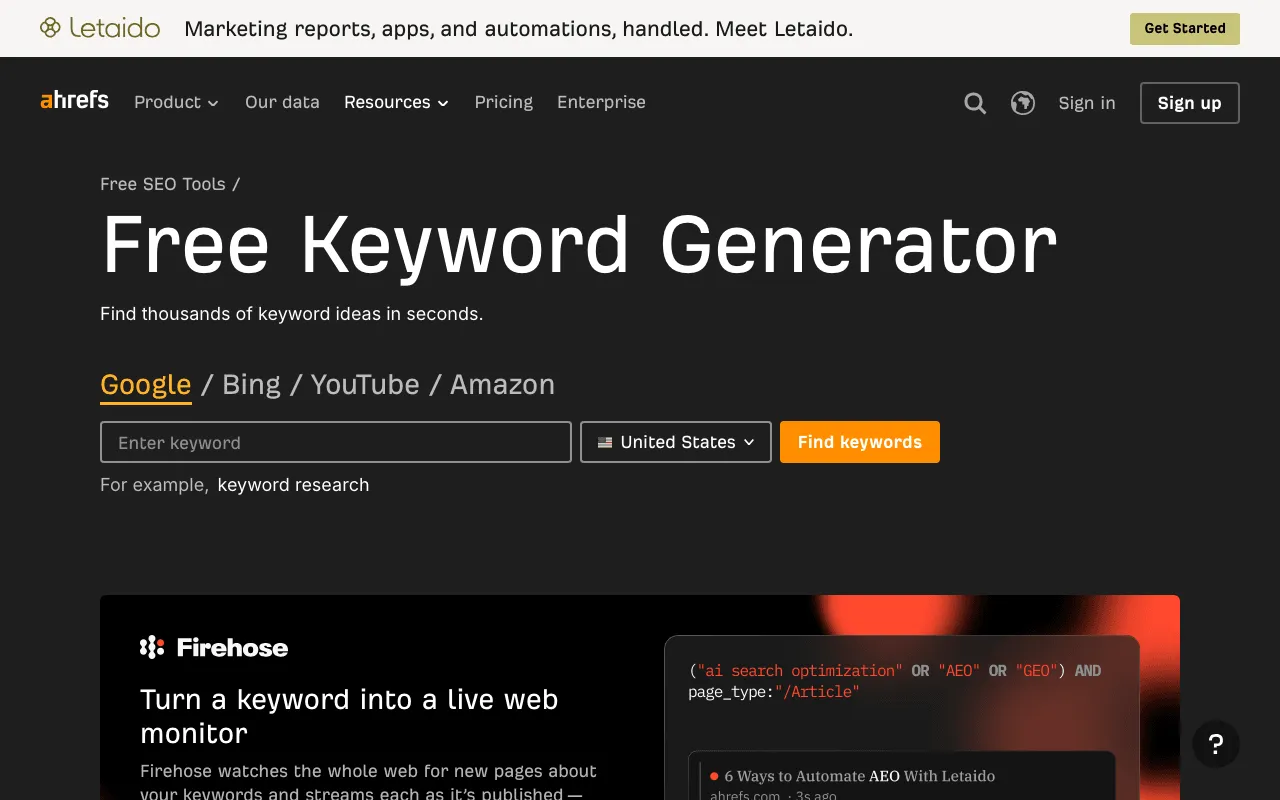
Ahrefs’ free Keyword Generator page. Screenshot of ahrefs.com/keyword-generator, taken October 30, 2026.
Other free entry points: Ubersuggest’s free plan allows 3 searches a day, and Semrush Free gives 10 reports a day (fact sheets, October 29, 2026). Google Keyword Planner calls itself “a free resource”, but you need a Google Ads account and a campaign to open it. Our page is Google Keyword Planner free walks through it.
Step 3: check the numbers behind each idea
Add the monthly volume next to each keyword, then the intent. Don’t trust a single number blindly: two tools rarely agree. Our guide to search volume shows real gaps between tools.
Step 4: give each keyword its own page
Group the lines that express the same need, and give each group one page. Before you create a page, check whether one of your pages already shows up for that search: our guide to check website keywords shows where to look.
Keyword stuffing and other list mistakes
Google defines it in its spam policies: “Keyword stuffing refers to the practice of filling a web page with keywords or numbers in an attempt to manipulate rankings in Google Search results” (read October 30, 2026). One natural mention in the right places beats twenty forced ones.
Forgetting the full customer journey
A list made only of buying keywords misses the people who aren’t ready yet. Keep a few “how to” topics: they bring visitors who will remember you when they buy. The opposite mistake is worse: a list of only questions, with no page that sells.
A list you never revisit
Searches change with seasons, trends and your own offer. Look at your list once a month and add what your customers asked lately.
Demo: a keyword list grouped by page with SemChat
Grouping a long list takes time. On October 29, 2026, Jérémy handed that job to SemChat, on the topic of his French site plugkit-avis.com (tools to automate social media for small businesses). The test ran in French, on the French market: the keywords below are French words, and the request is translated here.
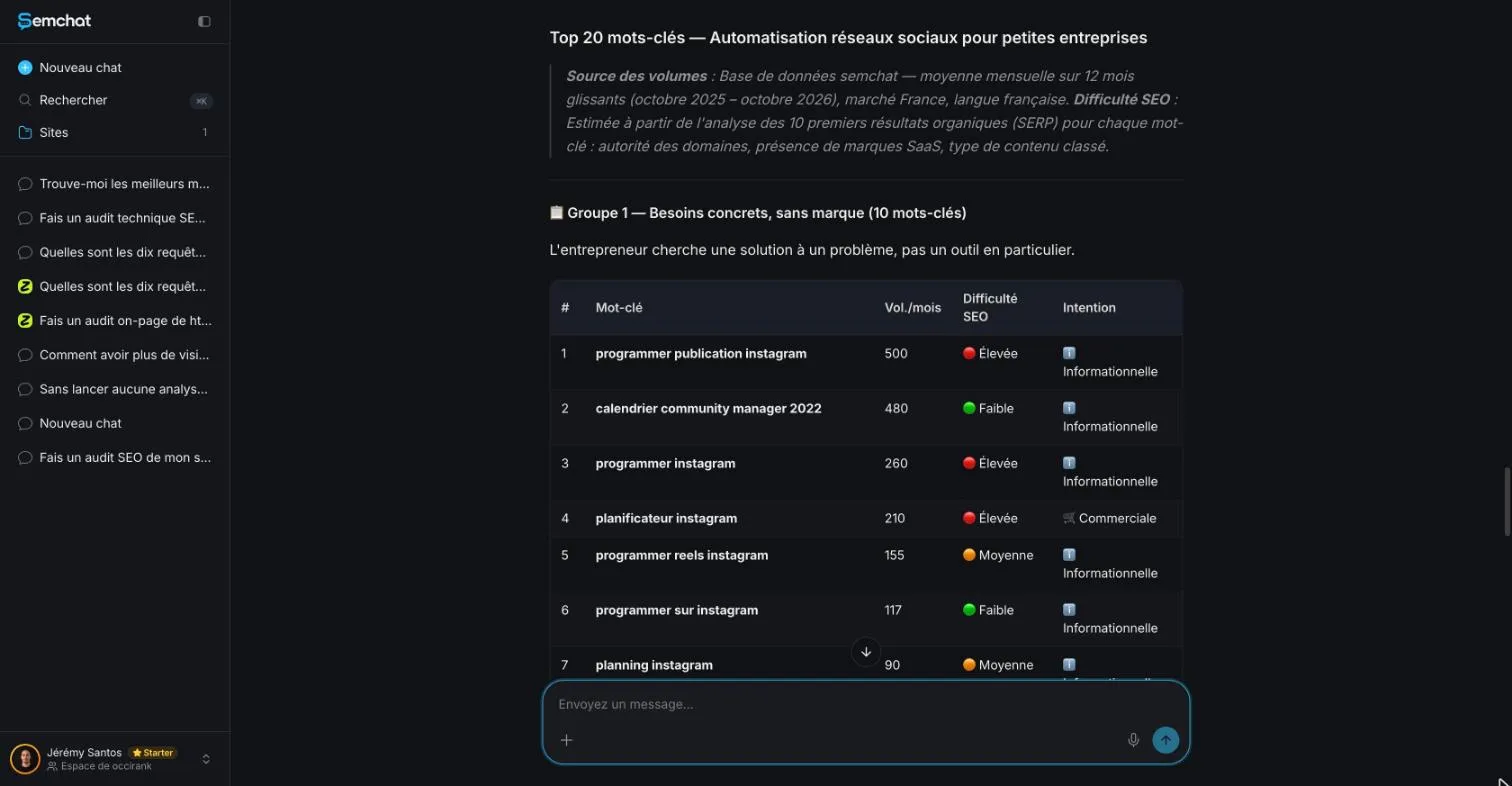
Keywords grouped by SemChat around one need. Screenshot of the SemChat app (Jérémy’s account, interface in French), October 29, 2026.
The sentence typed and the Keyword Clustering skill
First try: the “Keyword research” card on the home screen and its ready-made sentence. The result had 20 keywords, 15 of them brand names, and a “difficulty” taken from ad competition.
Second try, with the Keyword Clustering skill from the Skills menu and a precise request (translated): group the keywords, give an SEO difficulty, add needs without brand names, cite the source of the volumes, sort the groups by intent and keep five keywords that lead to a purchase.
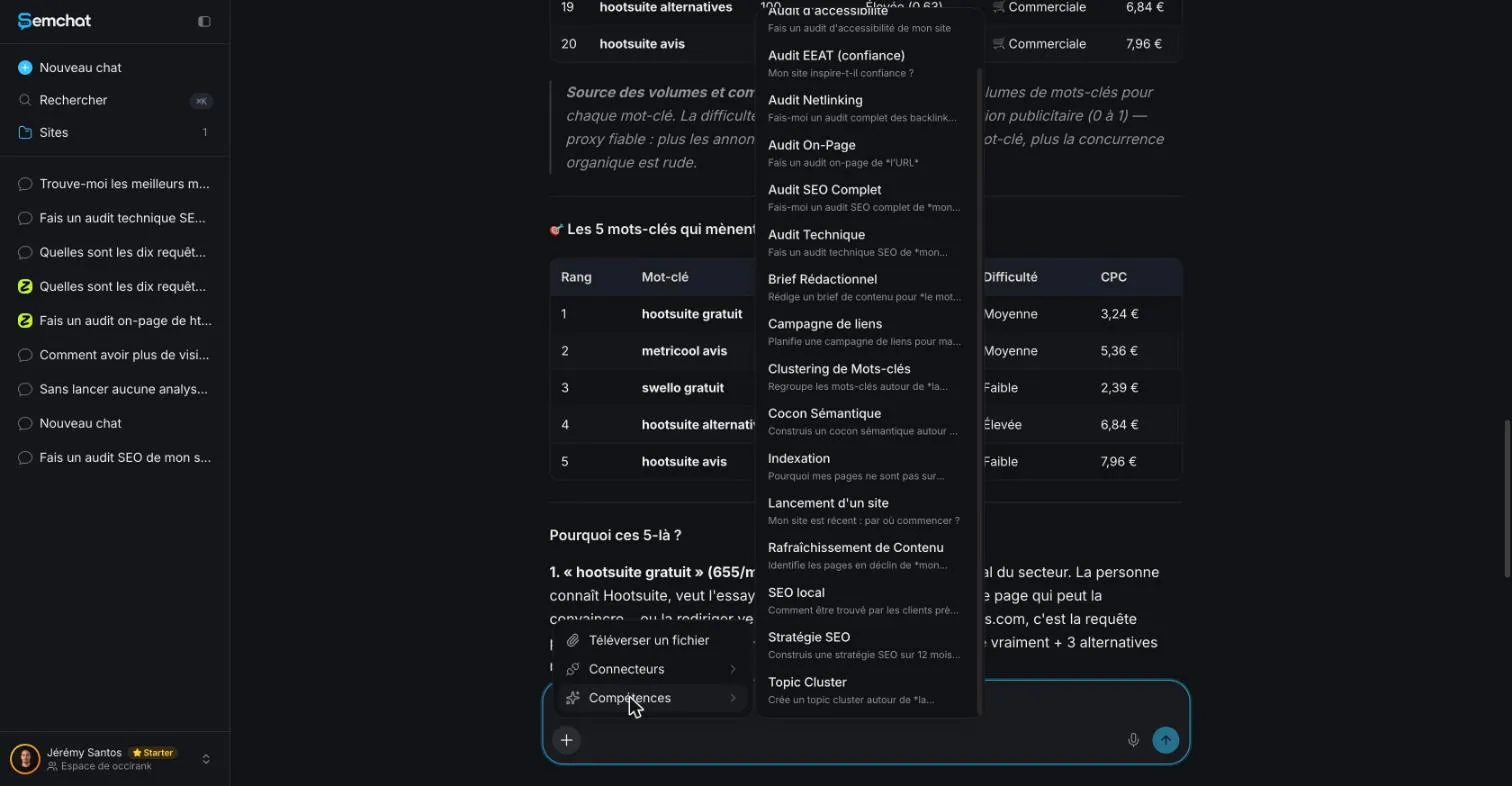
SemChat’s Skills menu with Keyword Clustering. Screenshot of the SemChat app (Jérémy’s account, interface in French), October 29, 2026.
What it got right, and what had to be corrected
SemChat opened with “You’re right on all three points” (translated). Then it delivered groups sorted by intent (needs without brands, then brands with buying intent), an SEO difficulty estimated from the top 10 Google results, and the source of its volumes: its own database, a 12-month rolling average for France.
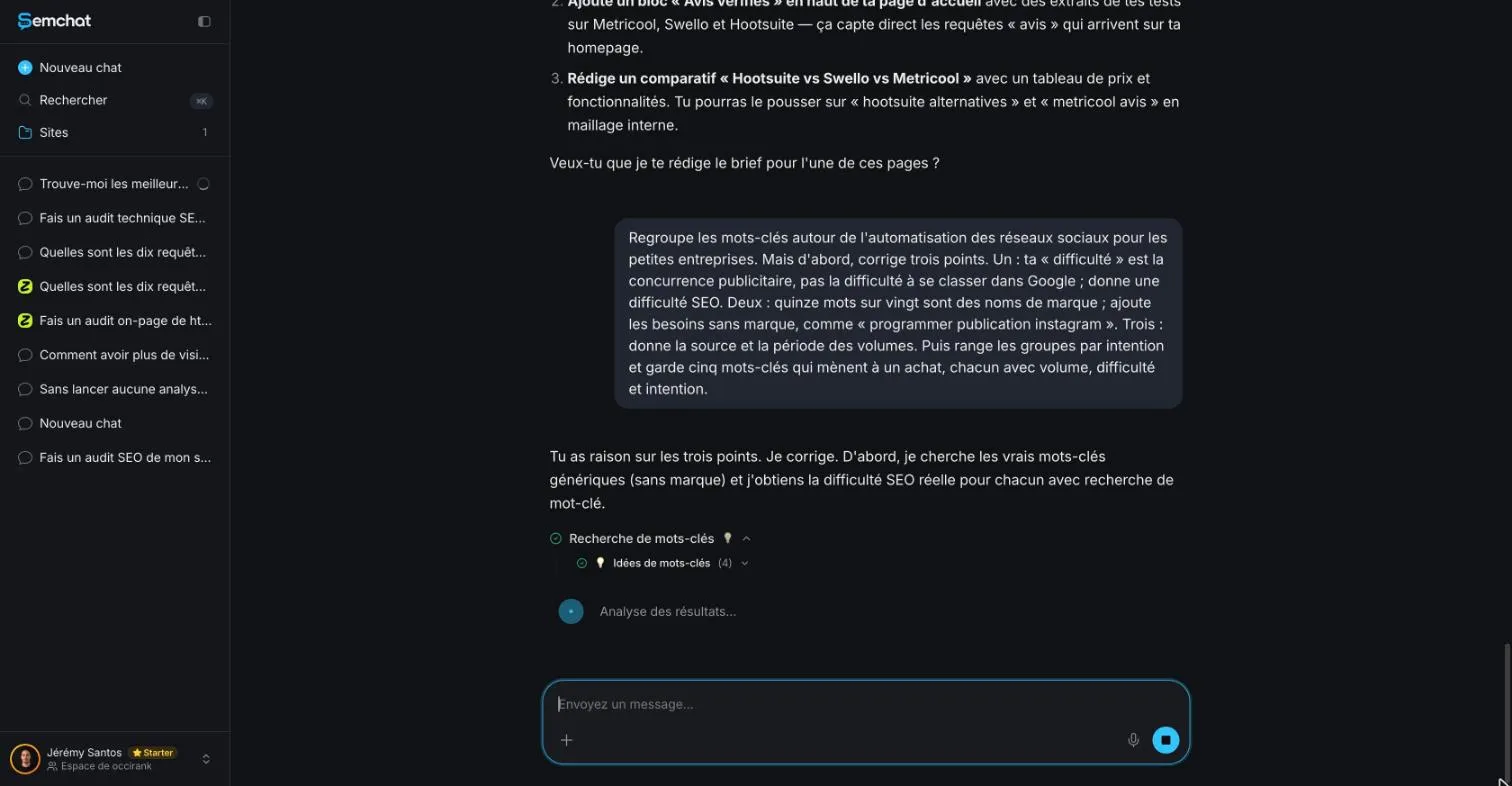
SemChat accepts the three errors pointed out and runs its research again. Screenshot of the SemChat app (Jérémy’s account, interface in French), October 29, 2026.
What had to be corrected, checked the same day:
- Volumes far from DataForSEO Google Ads (France): “hootsuite gratuit” at 655 in SemChat against 140, “swello gratuit” at 110 against 20.
- A dated keyword kept in the list (“calendrier community manager 2022”).
- Pages suggested that already existed on the site.
The takeaway: SemChat does the sorting fast and corrects itself when you point at precise errors. Cross-check its volumes with a second source and check your existing pages before you create one.
The best SEO keywords examples come from your own customers, checked against real numbers and sorted by intent. Start with twenty lines, give each need its own page, and add to the list every month.
Frequently asked questions
How do SEO keywords work?
A keyword is the phrase someone types into Google. When your page uses the same words and answers the need behind them, Google can match it to that search. Google's own starter guide says to think about the words a user might search for to find your content.
How many types of keywords are there in SEO?
There's no official count. A useful split for a small business: by length (short searches versus long-tail phrases) and by intent (looking for information, comparing, buying, or looking for a brand or a place). That gives you enough to sort any list.
How do you use keywords in a sentence?
Write the sentence for the reader first, then check the keyword appears naturally: in the page title, the main heading and the first paragraph. Don't repeat it everywhere. Google calls filling a page with keywords to manipulate rankings keyword stuffing, and treats it as spam.
Where can I find keyword examples for free?
Google itself: autocomplete, "People also ask" and related searches. Then a free tool: Ahrefs' Keyword Generator shows the first 100 ideas without an account, Ubersuggest's free plan allows 3 searches a day, and Google Keyword Planner is free once you have a Google Ads account with a campaign.
Let your AI do the chores of getting found online.
10% off your subscription, for life with my link, if you subscribe within 2 weeks of signing up. No code. All about the SemChat promo code
Affiliate link: it costs you nothing extra.
Verified sources
- Google Search Central: SEO Starter Guide (October 30, 2026)
- Google Search Central: spam policies (keyword stuffing) (October 30, 2026)
- Ahrefs Keyword Generator (October 30, 2026)
- Google Ads: Keyword Planner page (FAQ) (October 30, 2026)
- Google Ads: Keyword Planner page, French version (FAQ on competition) (October 30, 2026)
- Ubersuggest pricing (October 29, 2026)
- Semrush pricing (October 29, 2026)
- SemChat pricing (October 29, 2026)