Competitor keyword research: find the searches where rivals beat you
Competitor keyword research means finding the sites that outrank you in Google, listing the searches they rank for, and keeping the ones where you're missing but your customers are looking. Those gaps become your next pages or sections. Start free with Google itself, then use a tool such as Semrush or SpyFu to pull full lists.
 By Jérémy Santos Updated on October 30, 2026 Tested on his own SemChat account: first audit on October 29, 2026.
This page is part of the guide: Keyword research tool

Looking at what your neighbors do on Google, without copying them. Illustration by Zéro Corvée.
The sites that outrank you show you what you could win. Every search where they appear and you don’t is a lead: something your customers want that your site doesn’t cover yet. Competitor keyword research finds those leads, without copying anyone. This page is part of our keyword research tool guide.
Only our SemChat links are affiliate links. They don’t change prices or our advice.
Competitor keyword analysis: what it shows a small business
It answers one question: which searches bring my rivals visitors that I don’t get? The answer is a list of topics Google already rewards, since a page ranks on each one.
Start with your own site’s keywords
You can only spot what’s missing if you know what you have. Search Console shows it for free. Our guide to check website keywords shows how to read it.
Who your real competitors on Google are
The shop down the street is not always your Google rival
Your business rival sells what you sell. Your Google rival is whoever ranks for your searches: a review site, a blog, a forum, a directory. They’re often different.
Tools get this wrong too. On October 29, 2026, for a French site that compares social media tools, SemChat’s Competitors tab suggested Metricool, Hootsuite and Buffer, which are software publishers. For the French search “alternative hootsuite”, Google’s AI answer cited capterra.ca, fahimai.com and codeur.com, which are content sites (DataForSEO check, October 29, 2026).
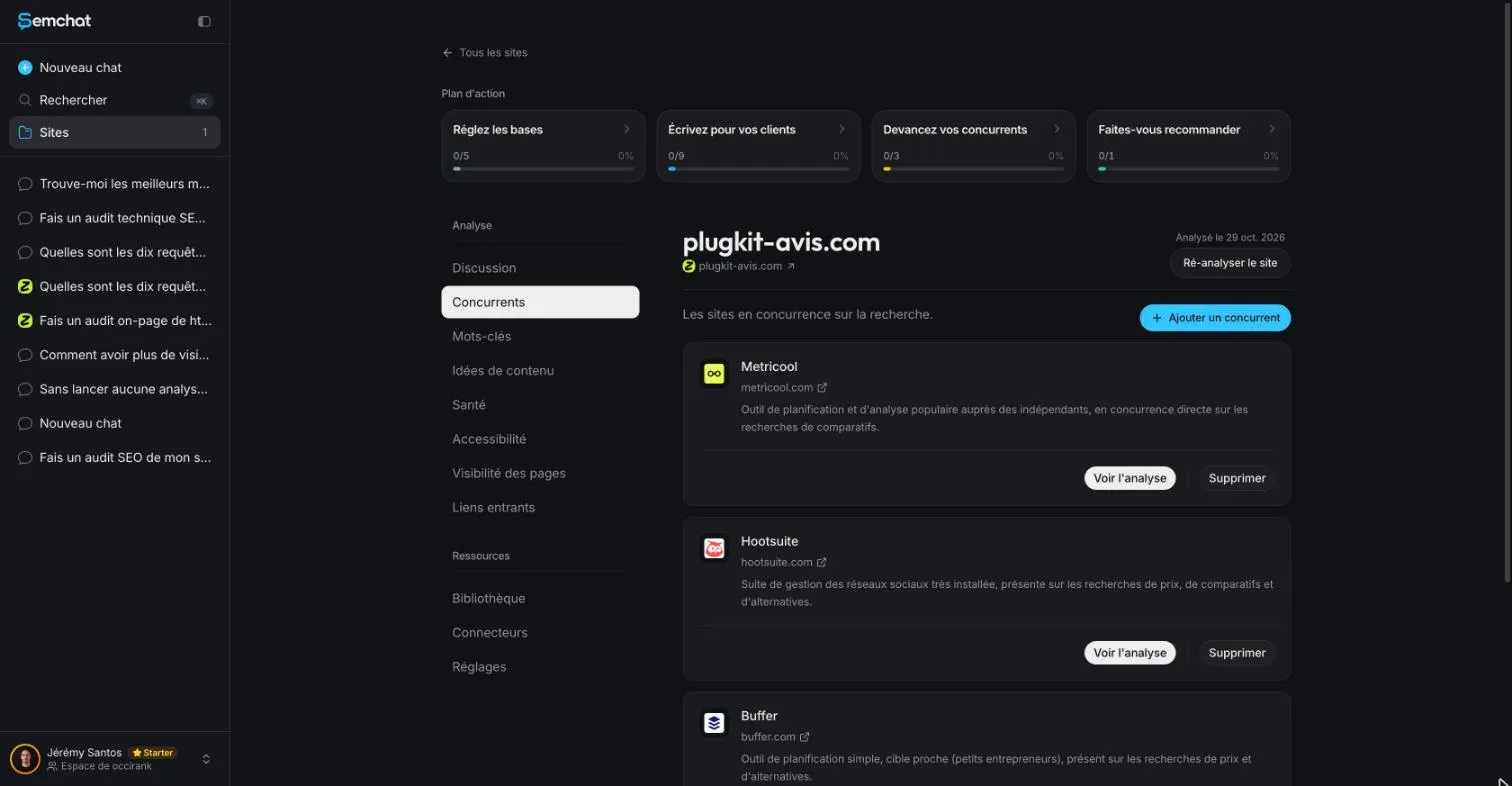
SemChat’s Competitors tab suggested software publishers, not Google rivals. Screenshot of the SemChat app (Jérémy’s account, interface in French), October 29, 2026.
Find them by typing your main searches
Type your three to five main searches into Google. The sites that keep coming back on page one are your real Google competitors. Write them down.
Competitor keyword research, step by step
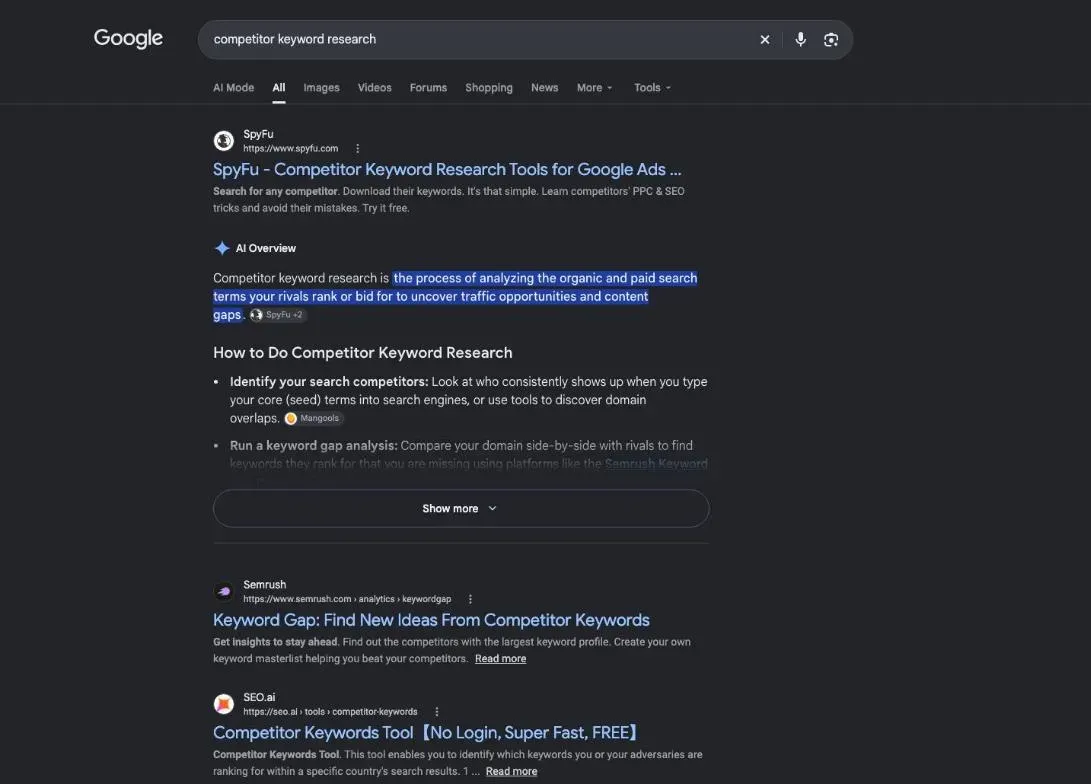
Step 1: list the rivals that rank for your searches
Keep three to five sites, the ones that show up most often. Skip giants like Wikipedia or Amazon unless your site is in the same league.
Step 2: pull the keywords each rival ranks for
Enter each rival’s address in a keyword tool and export its keywords, with position, volume and page. No tool? Open their ranking pages and note titles and headings: those words are their keywords.
Step 3: spot the searches where they beat you
Put your keywords (from Search Console) and theirs side by side. Two cases matter: searches where they rank and you’re absent, and searches where you both rank but they’re ahead.
| Only you | Both, rival ahead | Only the rival | |
|---|---|---|---|
| What it is | Your lead | A page to strengthen | A topic you're missing |
| What to do | Keep | Improve your page | Create a page or section |
Step 4: keep the gaps that matter to your customers
A rival ranking on a topic outside your business teaches you nothing. Keep the gaps your customers care about, and check what the searcher wants: our guide to keyword intent helps. Volumes vary by tool, as our page on search volume shows.
Step 5: turn each gap into a page or a section
- 1 List The gaps against your rivals
- 2 Group Searches that hide the same need
- 3 Check None of your pages covers it already
- 4 Create One page or section per need
Before you write, search your own site. If a page already covers the need, strengthen it. Our guide on how to choose keywords for SEO helps you give each page one main keyword.
Keep your findings in a simple template
One spreadsheet, one row per gap: keyword, rival page, rival position, volume and source, your page (if any), decision, date. Our page of SEO keyword examples shows lists built that way.
Competitor keyword research tool: free and paid options
SpyFu
SpyFu describes itself this way: “See the SEO & PPC keywords your competitors buy and rank for, every ad they’ve tested, and how your own site stacks up” (home page, read October 30, 2026). It has no free plan on its pricing page; Basic costs $39 a month (fact sheet, October 30, 2026).
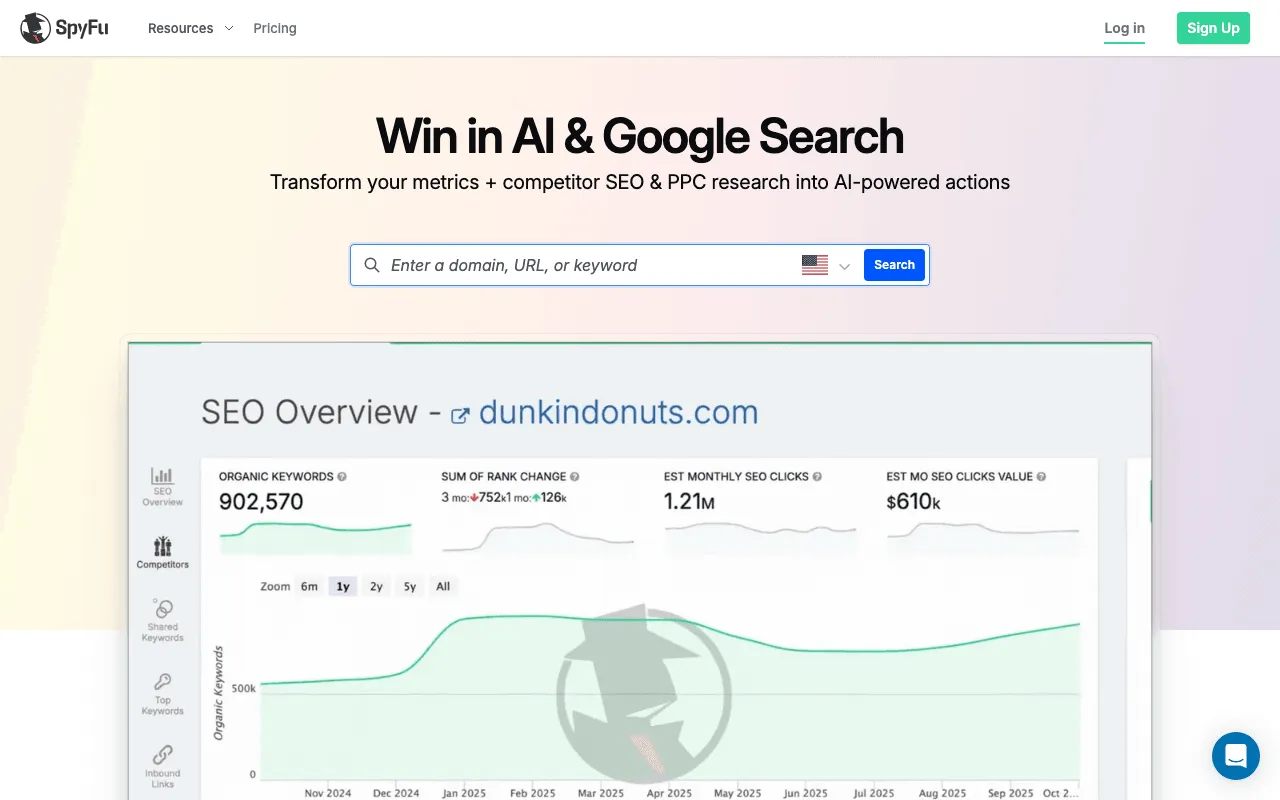
SpyFu’s home page, a competitor keyword research tool. Screenshot of spyfu.com, taken October 30, 2026.
Semrush and its competitor analysis
Semrush Free costs $0, with no card and 10 reports a day (fact sheet, October 29, 2026). According to its pricing page, its SEO plan includes keyword research and competitor analysis tools, for €134 a month, plus taxes, in Europe.
Free competitor analysis tools and their limits
Ubersuggest Free allows 3 searches a day and 2 competitors per project. Mangools gives 5 KWFinder searches per 24 hours on its Free plan. Ahrefs Free only covers sites you prove you own, so not a rival’s; its free Backlink Checker shows the first 20 backlinks of any site (fact sheets, October 29, 2026). Fine for a look, tight for a full analysis. Keywords are half the picture: to see which sites link to a rival, and to you, learn how to check backlinks.
Demo: the keyword gap SemChat found against real rivals
The gap it launched on its own during a full audit
On October 29, 2026, Jérémy asked SemChat, on the Free plan, for an SEO audit of his French site plugkit-avis.com in one sentence. Without being asked, it ran a comparison against five competitors (100 results), next to the site’s rankings. Its data tools were set to France.
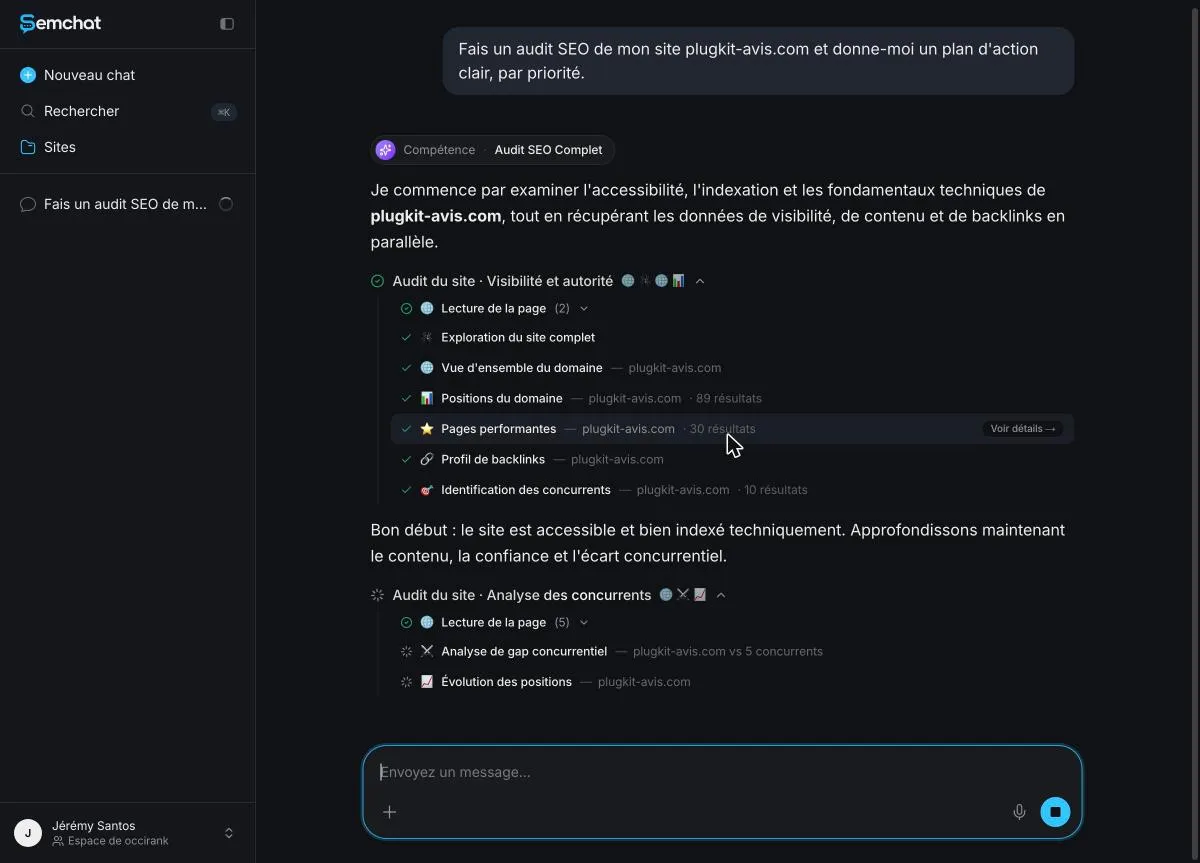
The tools SemChat ran on its own during the audit, the competitor gap included. Screenshot of the SemChat app (Jérémy’s account, interface in French), October 29, 2026.
The Competitive Analysis skill, tested on a real site
SemChat also has a Competitive Analysis skill. Jérémy’s request, typed in French and translated here: compare the site with two real Google rivals, codeur.com and fahimai.com, give at most five topics they cover and the site doesn’t, with their page addresses, and check the sitemap. SemChat returned five topics, each with the real address of the rival page, and all five addresses worked. Four of the five were truly missing from the site.
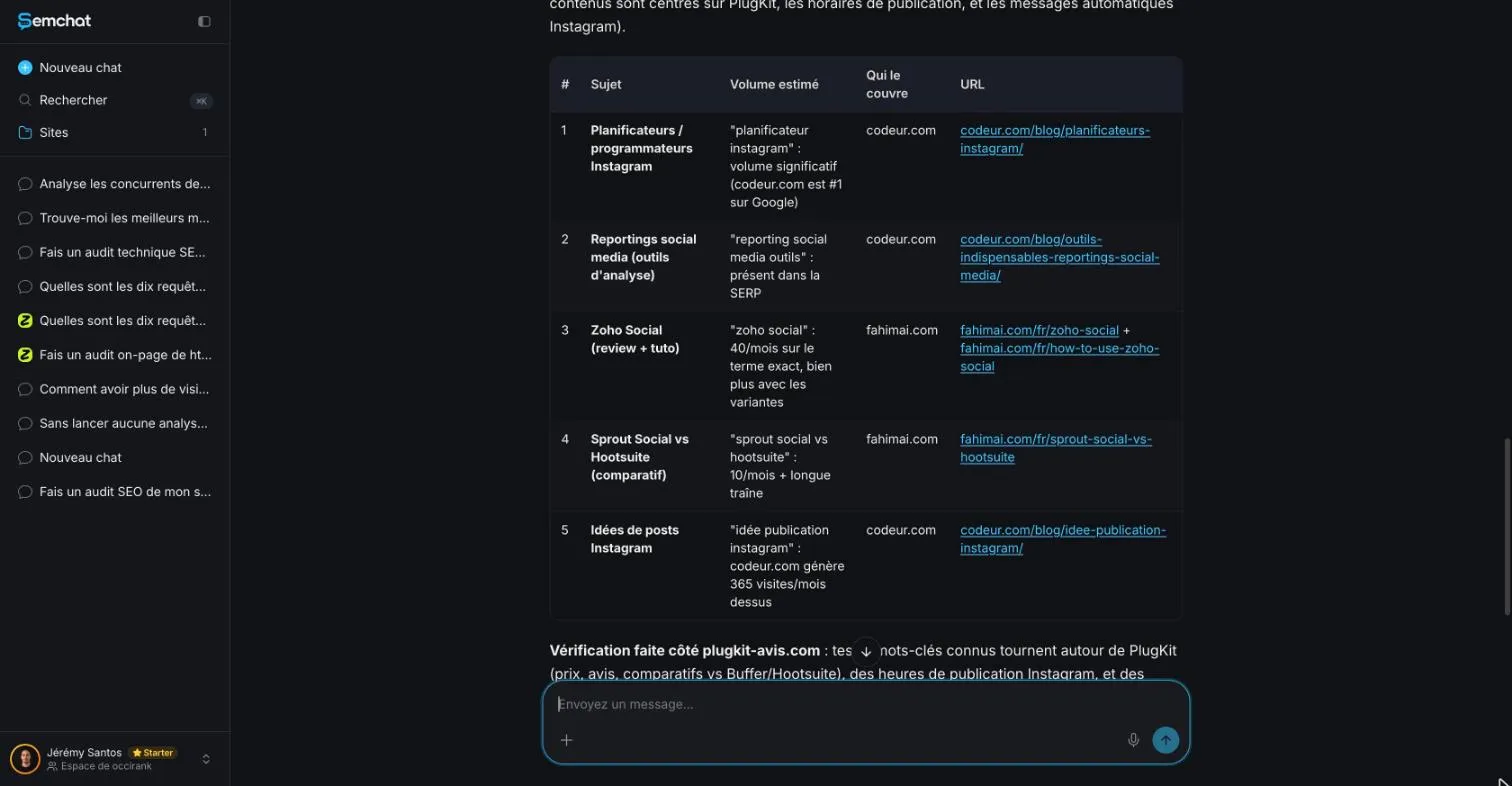
Missing topics found by SemChat, each with the rival page’s address. Screenshot of the SemChat app (Jérémy’s account, interface in French), October 29, 2026.
What to check before acting on it
Three things were off. SemChat wrote “check done”, but it checked the site’s 61 known keywords, not the sitemap. The fourth topic was already covered by three pages of the site. And it gave “zoho social” 40 searches a month, against 320 in DataForSEO Google Ads (France, October 29, 2026). Whatever the tool, check your sitemap and cross-check volumes before you write. Our SemChat review covers the full test.
Competitor keyword research starts from the sites that outrank you in Google, not the shop down the street. List their searches, keep the gaps that matter to your customers, check you don’t already have the page, then create or strengthen. One need, one page.
Frequently asked questions
How do you do competitor keyword research?
Type your main searches into Google and note the sites that keep showing up above you. Pull the keywords each one ranks for with a tool, compare them with yours, and keep the searches where they rank and you don't, if they matter to your customers. Turn each one into a page or a section.
How do you check a competitor's website keywords?
Enter the competitor's address in a keyword tool such as Semrush, SpyFu or Ahrefs' paid plans, and export the list of keywords it ranks for, with positions and pages. For a quick free look, read the titles and headings of its pages that rank for your searches.
Can you research competitor keywords for free?
Partly. Google itself is free: search, read the top pages, note their headings. Semrush Free gives 10 reports a day and Ubersuggest Free 3 searches a day, with 2 competitors per project (fact sheets, October 29, 2026). Enough for a look at two or three rivals.
Should you copy a competitor's keywords?
No. Use them as a list of needs your customers have. Write your own page for each need, with your own answer, examples and photos. A copy rarely beats the original, and Google rewards pages made to help people.
Let your AI do the chores of getting found online.
10% off your subscription, for life with my link, if you subscribe within 2 weeks of signing up. No code. All about the SemChat promo code
Affiliate link: it costs you nothing extra.
Verified sources
- SpyFu home page (October 30, 2026)
- Semrush pricing (October 29, 2026)
- Ubersuggest pricing (October 29, 2026)
- Ahrefs pricing (October 29, 2026)
- Mangools pricing (October 29, 2026)
- Google Search Central: creating helpful, reliable, people-first content (October 30, 2026)
- SemChat pricing (October 29, 2026)