Competitor analysis SEO tools: find your real rivals in Google
Competitor analysis SEO tools compare your site with the sites that rank ahead of you in Google, not with the big brands in your industry. I tested SemChat's competitor analysis skill on October 29, 2026: it found 5 topics two rivals cover, each with the real address of their page. One of the five was already on my site, so check your sitemap before you write.
 By Jérémy Santos Updated on October 30, 2026 Tested on his own SemChat account: first audit on October 29, 2026.
This page is part of the guide: automated SEO

Compare your site with your real rivals in Google, not with software vendors. Illustration by Zéro Corvée.
Your competitors in real life aren’t always the sites that beat you in Google. Competitor analysis SEO tools start from those sites: the ones Google shows before yours, and the topics they cover that you don’t.
This page explains what these tools compare, lists the ones most guides name (from their own pages, not tested here), and walks through the one I did test: SemChat’s competitor analysis skill, on my own site, on October 29, 2026. It’s part of our guide to automated SEO with SemChat. The SemChat buttons on this page are affiliate links.
SEO competitor analysis tools: what they compare
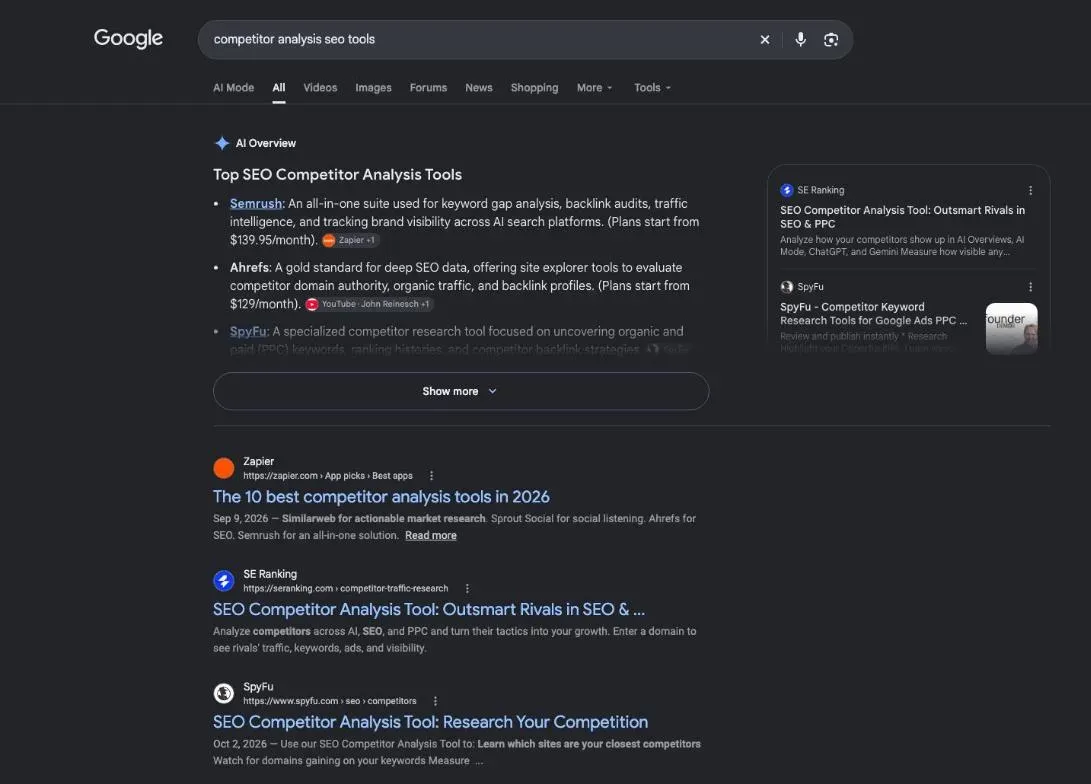
An SEO competitor analysis puts your site next to the sites holding the spots you want. The goal isn’t to copy them. It’s to see what you’re missing.
SEO competitor analysis: rankings, pages, links, keywords
Four comparisons cover most of it.
| Your site | Your rival | |
|---|---|---|
| Rankings | where you show up in Google | where it shows up for the same searches |
| Pages | the topics you cover | the topics it covers without you |
| Links | the sites that link to you | the sites that link to it |
| Keywords | the searches that bring you visits | the searches that bring it visits |
Most suites do all four. Some lean on one: SpyFu, for instance, puts the keywords and ads of competitors first. Others add traffic estimates, which are guesses built from panels or clickstream data, not counts.
Your competitors’ keywords, step by step
Keywords are the core: the searches that bring visits to them and not to you. The manual method, step by step, is on our competitor keyword research page. Below, I hand that job to SemChat and check what comes back.
Who needs a competitor analysis tool
A small business owner, a blogger, a solo founder: anyone who writes pages and wonders why another site ranks first. You don’t need a suite for that. You need to know who your real rivals are.
Your real rivals in Google, not the software vendors
Before running the skill, I opened the Competitors tab on my site’s page in SemChat. It listed Metricool, Hootsuite and Buffer: makers of social media software.
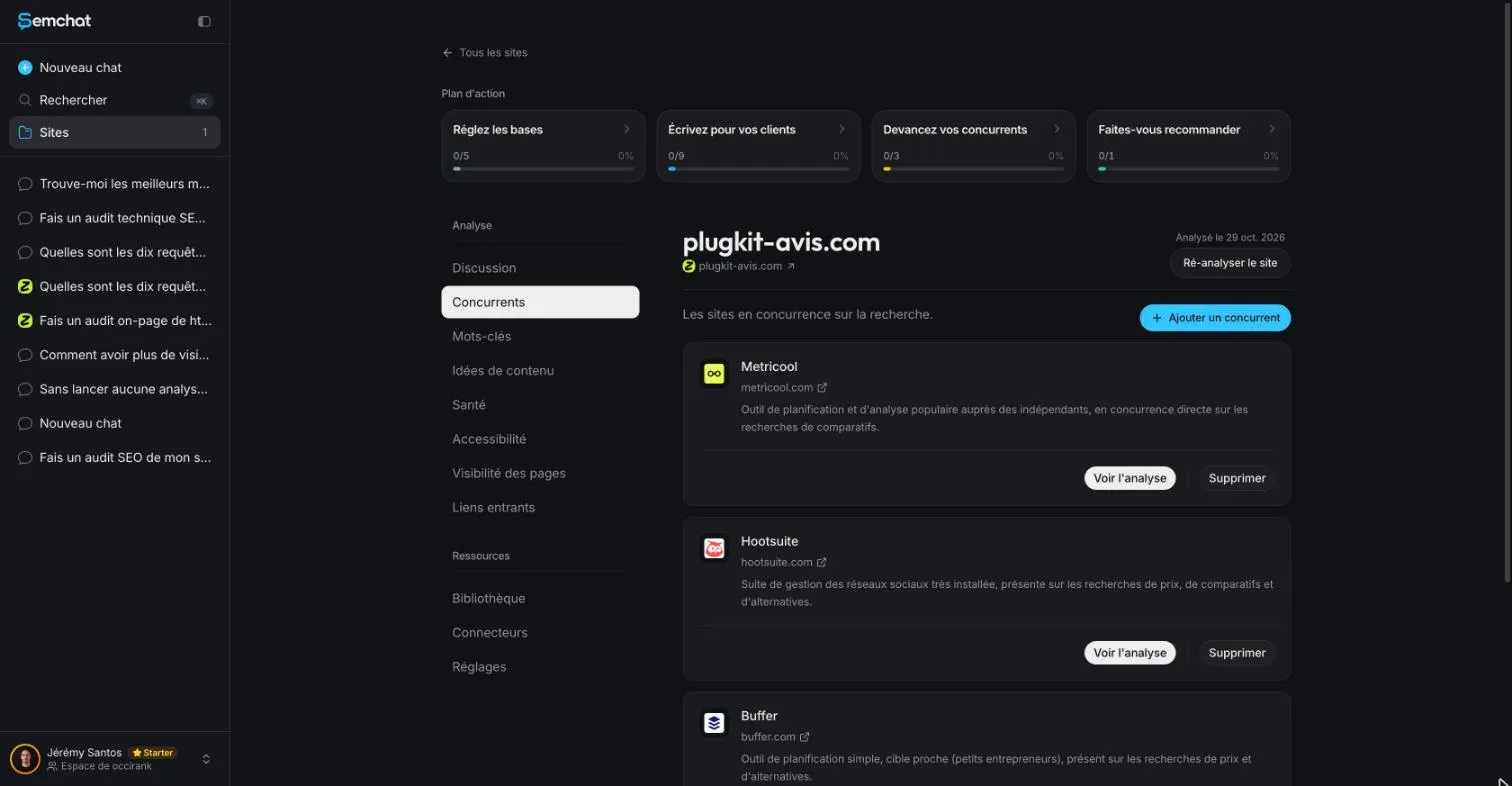
Those are the brands my site reviews, not the sites I compete with in Google. For the French search for a Hootsuite alternative (DataForSEO, France, October 29, 2026), the top organic results were capterra.ca, twism.substack.com and fahimai.com, and Google’s AI Overview cited codeur.com. Those are my real rivals: sites that compare tools, like mine.
The lesson works in any trade. A bakery’s rival in Google may be a recipe blog, not the bakery down the street.
What to look for before you pick a tool
Every tool shows numbers with confidence. Two questions sort them.
Accurate, fresh data
Data differs from one tool to the next, and the tools say so themselves:
- Ahrefs’ FAQ warns that “data depth varies significantly by market” (Ahrefs profile, October 29, 2026).
- SE Ranking’s FAQ admits that for search volume, “SE Ranking’s figures currently trail both competitors,” meaning Semrush and Ahrefs (SE Ranking profile, October 29, 2026).
- SpyFu’s help center says “Our current results track Google,” across 32 countries, with keyword rankings updated about once a month (SpyFu profile, October 30, 2026).
Freshness matters as much as accuracy. A ranking from last month may already be wrong.
Data checked against real results
Google is blunt about third-party tools: “Google doesn’t evaluate or endorse third-party SEO tools, and these tools don’t have access to Google’s internal ranking data” (Do you need an SEO?, read October 30, 2026). It adds: “Be wary of tools that claim to be “acceptable” or “approved” by Google Search.”
So check a tool’s numbers against a second source. In my test below, SemChat put a search at 40 a month; Google Ads put it at 320.
The competitor analysis tools most lists name
Here are the tools that come up most for this search, described only from their own pages as recorded in each tool’s dated profile on this site. None was tested here except SemChat.
| Tool | What its pages say about competitor analysis | Free option | Entry price, as read |
|---|---|---|---|
| Semrush | Competitor analysis tools from the SEO plan, Organic Rankings, Keyword Gap | Free plan, 10 reports a day | €134 a month (SEO plan, shown from France) |
| Ahrefs | Site Explorer: competitors’ pages, keywords, backlinks; Content Gap | Free plan for your own verified sites only | $29 a month (Starter, per its FAQ) |
| SE Ranking | Competitive Research, Backlink Gap Analyzer | 14-day trial, no permanent free plan | €109 a month (Core, shown from France) |
| SpyFu | Competitors’ keywords, ads and history, Kombat comparison | No free plan on the pricing page | $39 a month (Basic) |
| Similarweb | Competitors’ traffic, channels and alerts | Free “high-level sample” on its site | $199 a month (Competitive Intelligence) |
| Moz | A free Competitive Research tool in its menu | Free account with limited access | $49 a month (Moz Pro Starter) |
| Seobility | Up to 3 competitors tracked on Basic, gap analysis | Free Basic plan | €59.90 a month (Premium) |
| SemChat | Competitor analysis skill, run in a conversation (tested below) | Free plan at €0, every feature | €20 a month (Starter) |
Sources: each tool’s profile on this site (Semrush, Ahrefs, SE Ranking, Seobility: October 29, 2026; SpyFu, Similarweb, Moz: October 30, 2026); SemChat pricing read October 30, 2026. Prices are as displayed on each pricing page; tax rules differ from one tool to the next.
Competitor analysis tools for SEO: Semrush, Ahrefs, SE Ranking
These three are the full suites most guides open with.
- Semrush lists competitor analysis tools from its SEO plan, with Organic Rankings and Keyword Gap. Its Free plan gives one demo project and 10 reports a day. If its paid plans are beyond your budget, our Semrush alternative guide compares free plans and cheaper entry prices.
- Ahrefs centers on Site Explorer, which shows competitors’ organic and AI traffic, pages, keywords and backlinks, with Content Gap and Link Intersect. Its FAQ is clear that the free account isn’t for this job: “you can’t research competitors’ sites without paying.”
- SE Ranking offers Competitive Research (organic and paid keywords, traffic estimates, visibility over time) and a Backlink Gap Analyzer. No permanent free plan: a 14-day trial, no card required.
SpyFu, first in Google for this search
On October 29, 2026, SpyFu’s home page was the first organic result for this search in the United States (DataForSEO). Its pitch, read on October 30, 2026: “See the SEO & PPC keywords your competitors buy and rank for, every ad they’ve tested, and how your own site stacks up.”
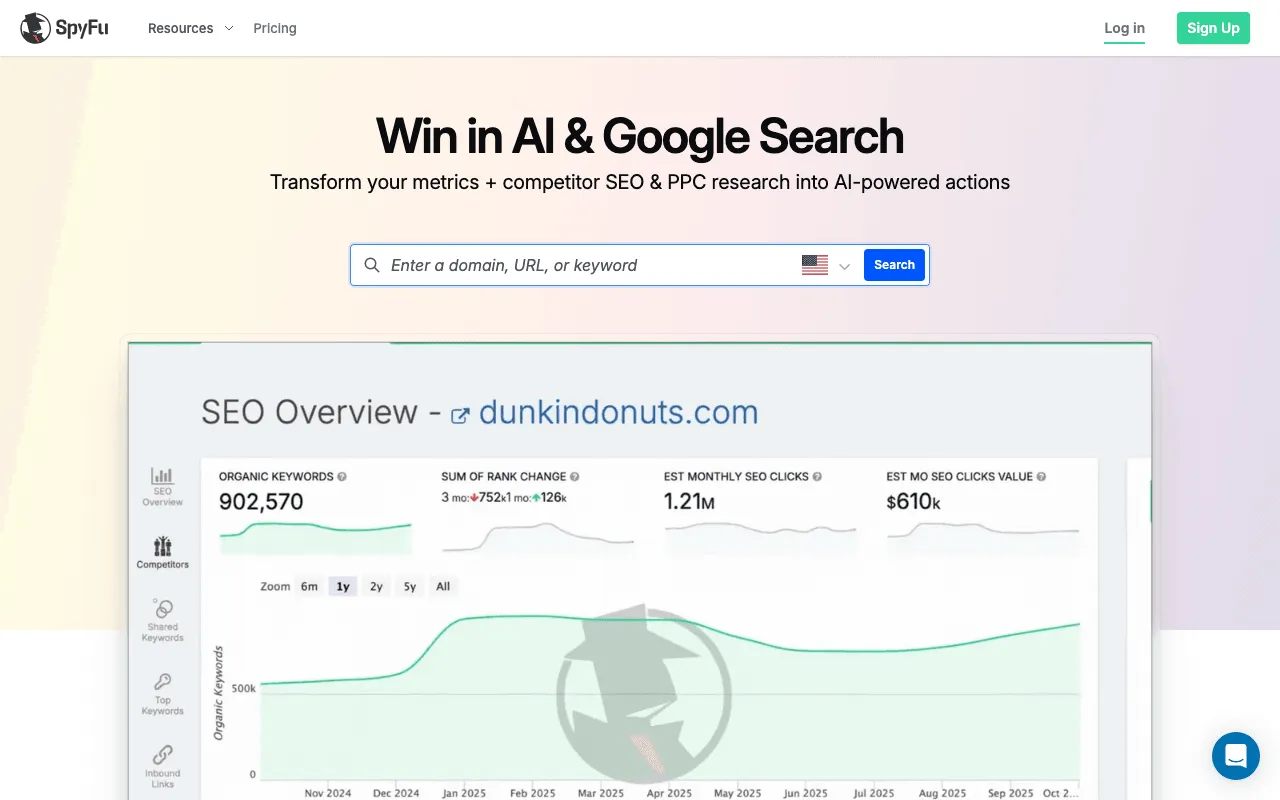
Its profile on this site notes the trade-offs: Google only, 32 countries, no free plan or trial on the pricing page, and a first month of Pro + AI at $59 instead of $119 (SpyFu profile, October 30, 2026). It suits advertisers who also watch paid search rivals.
Similarweb, Moz and Seobility
Google’s AI Overview for this search cited pages from all three on October 29, 2026.
- Similarweb is built around competitors’ traffic, marketing channels and alerts, from its Competitive Intelligence plan.
- Moz lists a free Competitive Research tool in its menu, next to Domain Analysis, and offers a free account with limited access to MozBar, Keyword Explorer and Link Explorer.
- Seobility tracks competitors side by side: 3 on the free Basic plan, up to 30 on Agency, with gap analysis against up to 2 competitors in its keyword tool.
A free competitor analysis: what you can do without paying
You can start for free. Type your main keyword into Google, note the sites ahead of you, open their pages, and list the topics you don’t cover. That’s a competitor analysis, done by hand.
Free SEO competitor analysis tool options and their limits
Tools speed this up, within their free limits, as read on their own pages:
- Semrush Free: 1 demo project, 10 reports a day.
- Seobility Basic: free forever, 1 project, 3 competitors.
- Moz: a free account with limited access, and a free Competitive Research tool in its menu.
- Ahrefs Free: for your own verified sites; competitor research needs a paid plan.
- SemChat Free: €0, and its pricing page says “Every feature, in every plan.” (read October 30, 2026). The competitor analysis skill is included; how far the Free quota stretches is the catch, as one request used 6.4 points of the larger Starter quota in my test.
10% off your subscription, for life with my link, if you subscribe within 2 weeks of signing up. No code. All about the SemChat promo code
Try SemChat for free Free plan, no credit card. Affiliate link: it costs you nothing extra.
Step 1: ask SemChat to compare you with two real Google rivals
SemChat is an SEO assistant you talk to: you type a sentence, it runs its tools, then it answers. I opened a new chat, picked the competitor analysis skill (“Analyse Concurrentielle” in the French interface) and didn’t link my site’s page.
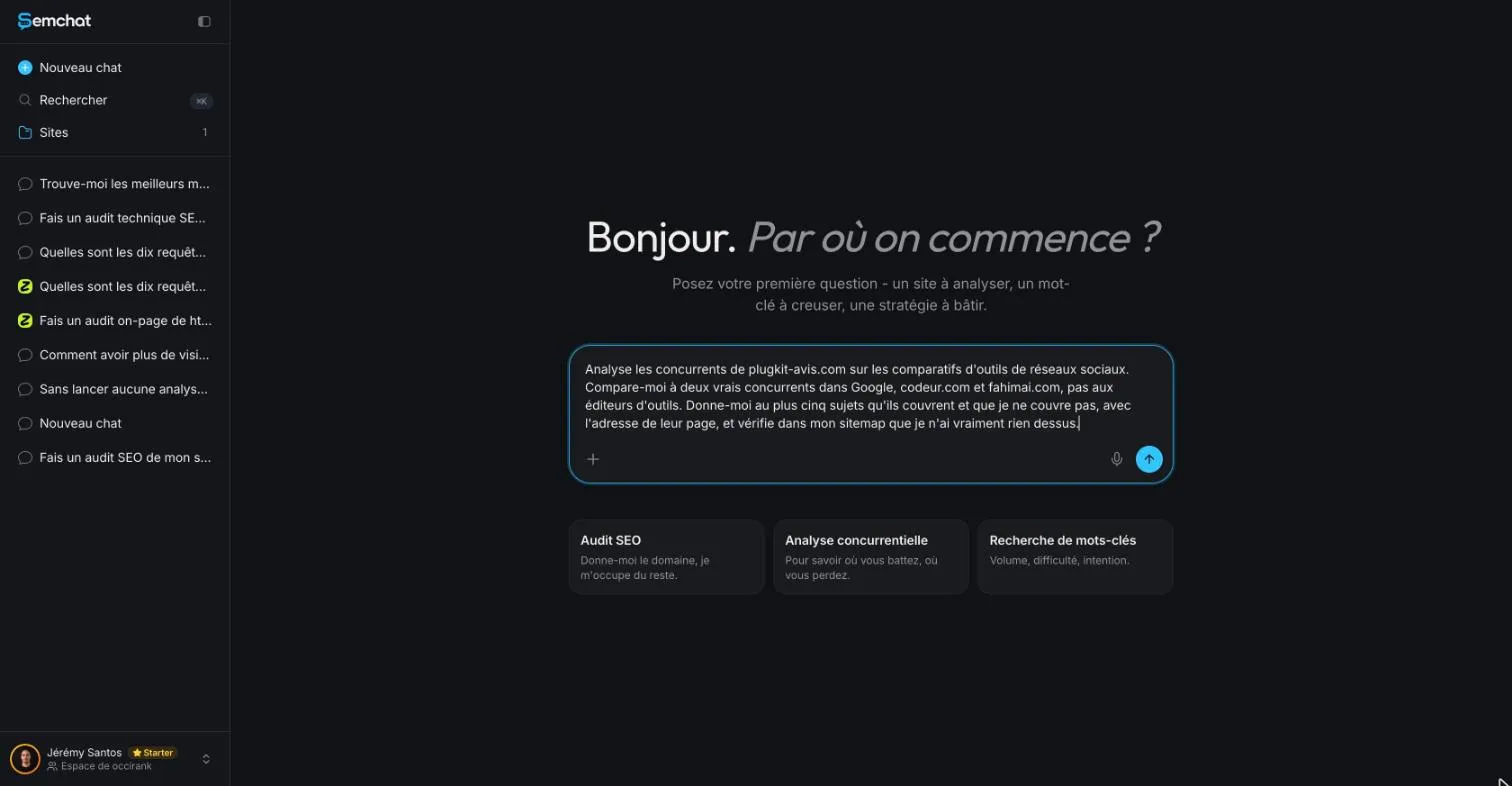
The precise request we typed, in French
The test ran in French, on a French site, with the interface in French. Here is the request as typed:
« Analyse les concurrents de plugkit-avis.com sur les comparatifs d’outils de réseaux sociaux. Compare-moi à deux vrais concurrents dans Google, codeur.com et fahimai.com, pas aux éditeurs d’outils. Donne-moi au plus cinq sujets qu’ils couvrent et que je ne couvre pas, avec l’adresse de leur page, et vérifie dans mon sitemap que je n’ai vraiment rien dessus. »
In English: analyze the competitors of plugkit-avis.com on social media tool comparisons; compare me with two real competitors in Google, codeur.com and fahimai.com, not with software vendors; give me at most five topics they cover and I don’t, with the address of their page, and check in my sitemap that I really have nothing on them.
Three things matter in that request: you name the rivals yourself, you set a limit (five topics at most), and you demand proof (the address of each page). How the same request performs in English is missing data: an English test is planned.
SemChat then ran its tools on screen: domain overview, competitor identification, domain rankings, a competitive gap analysis, top pages, search results and page reading.
Step 2: read the five topics, each with the rival page’s address
It returned five topics: Instagram schedulers, social media reporting, Zoho Social, Sprout Social versus Hootsuite, and Instagram post ideas. Each came with the address of the rival page.
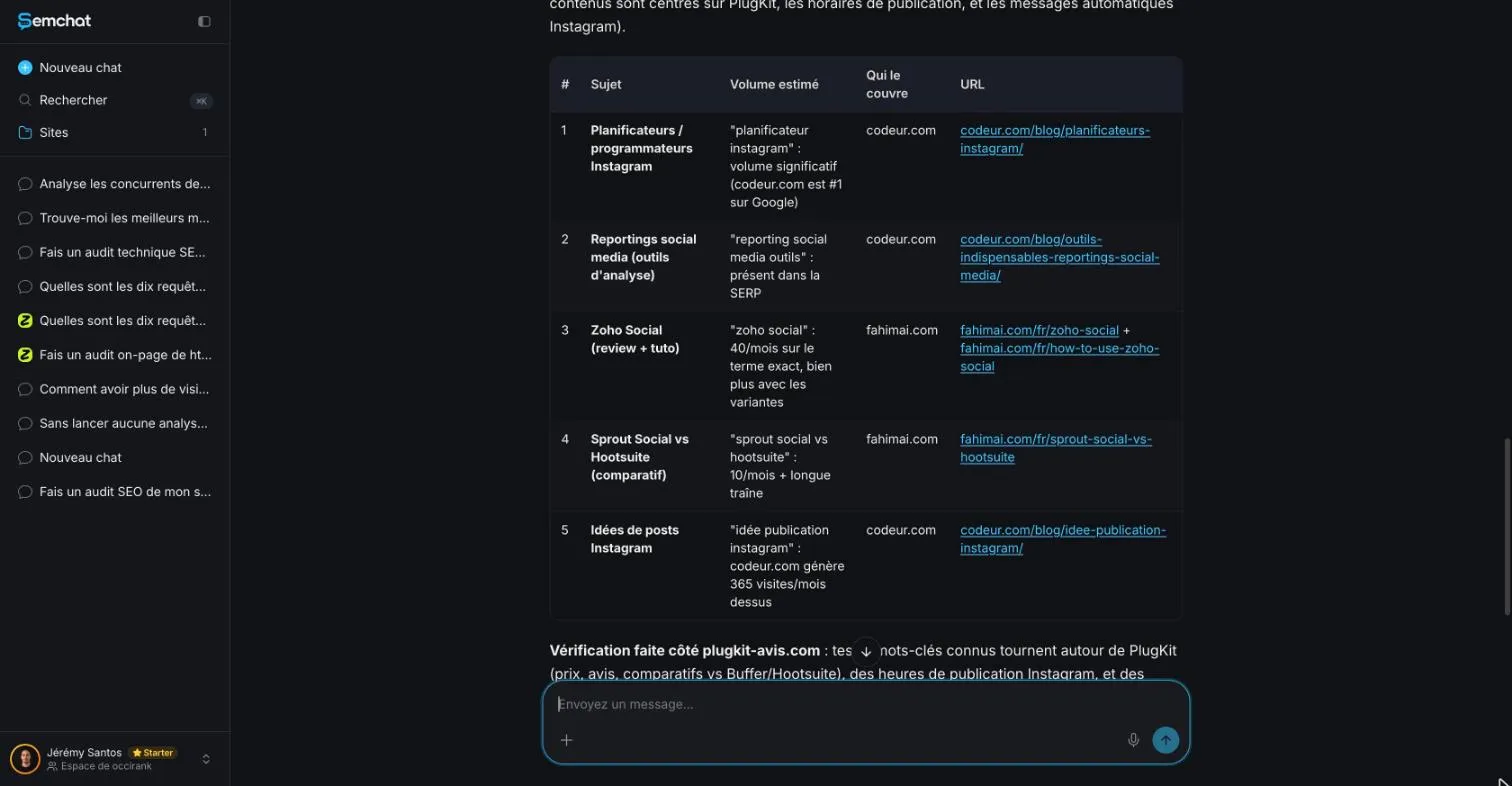
I checked the same day. All 5 addresses returned a 200 status. And 4 of the 5 topics really were missing from my site: its French sitemap of 51 URLs had no page on schedulers, reporting, post ideas or Zoho.
Three concrete actions to start with
SemChat closed with three actions for the week: a page on the best Instagram schedulers, a Sprout Social versus Hootsuite comparison in French, and a page of Instagram post ideas for entrepreneurs. Clear, and easy to act on. But the second one needed a check.
Step 3: re-check its claims in your sitemap
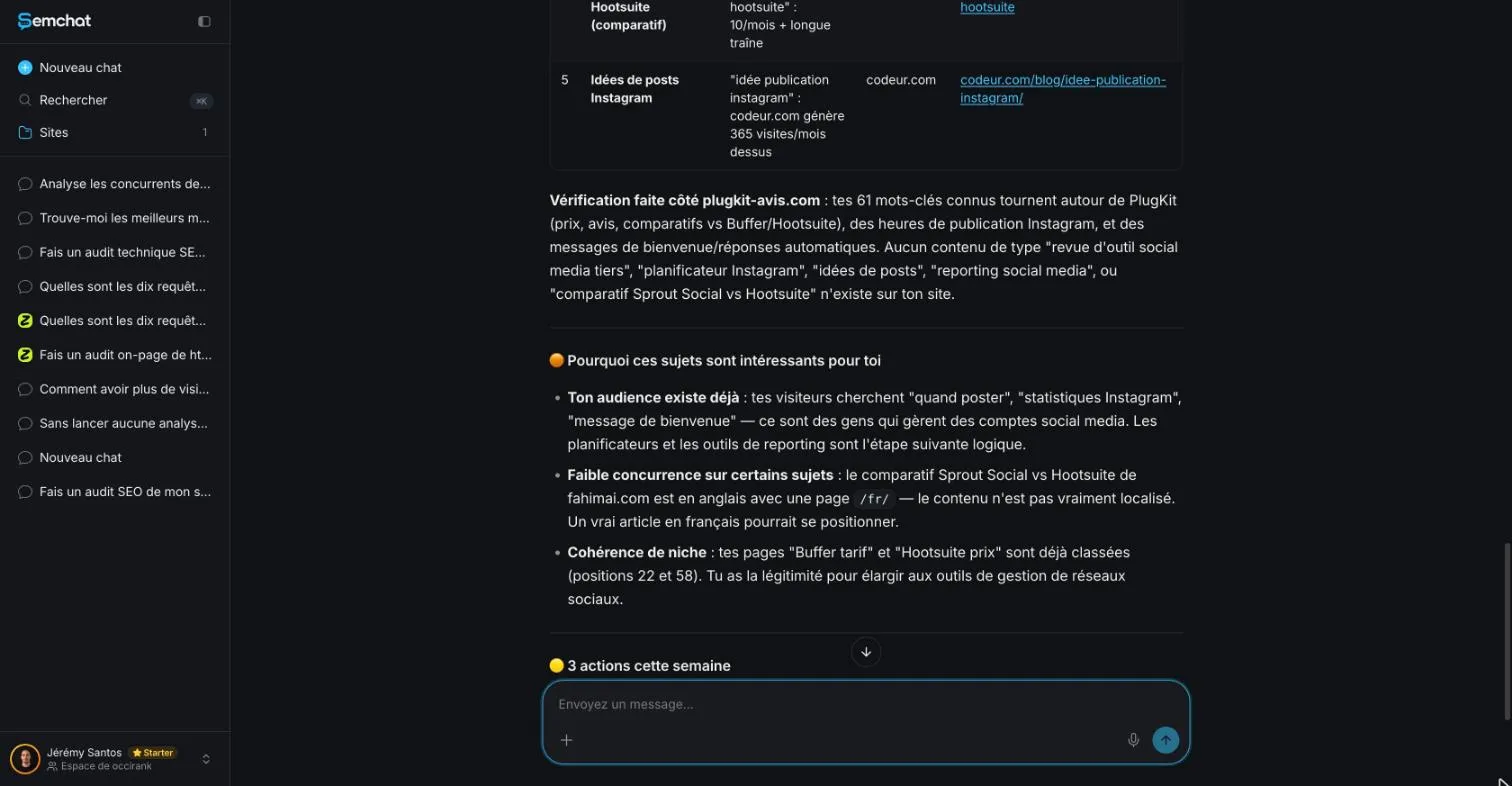
I had asked for a sitemap check. SemChat wrote “Vérification faite” (check done), but based it on the 61 keywords it knew for my site, not on the list of my pages.
A topic your site already covers
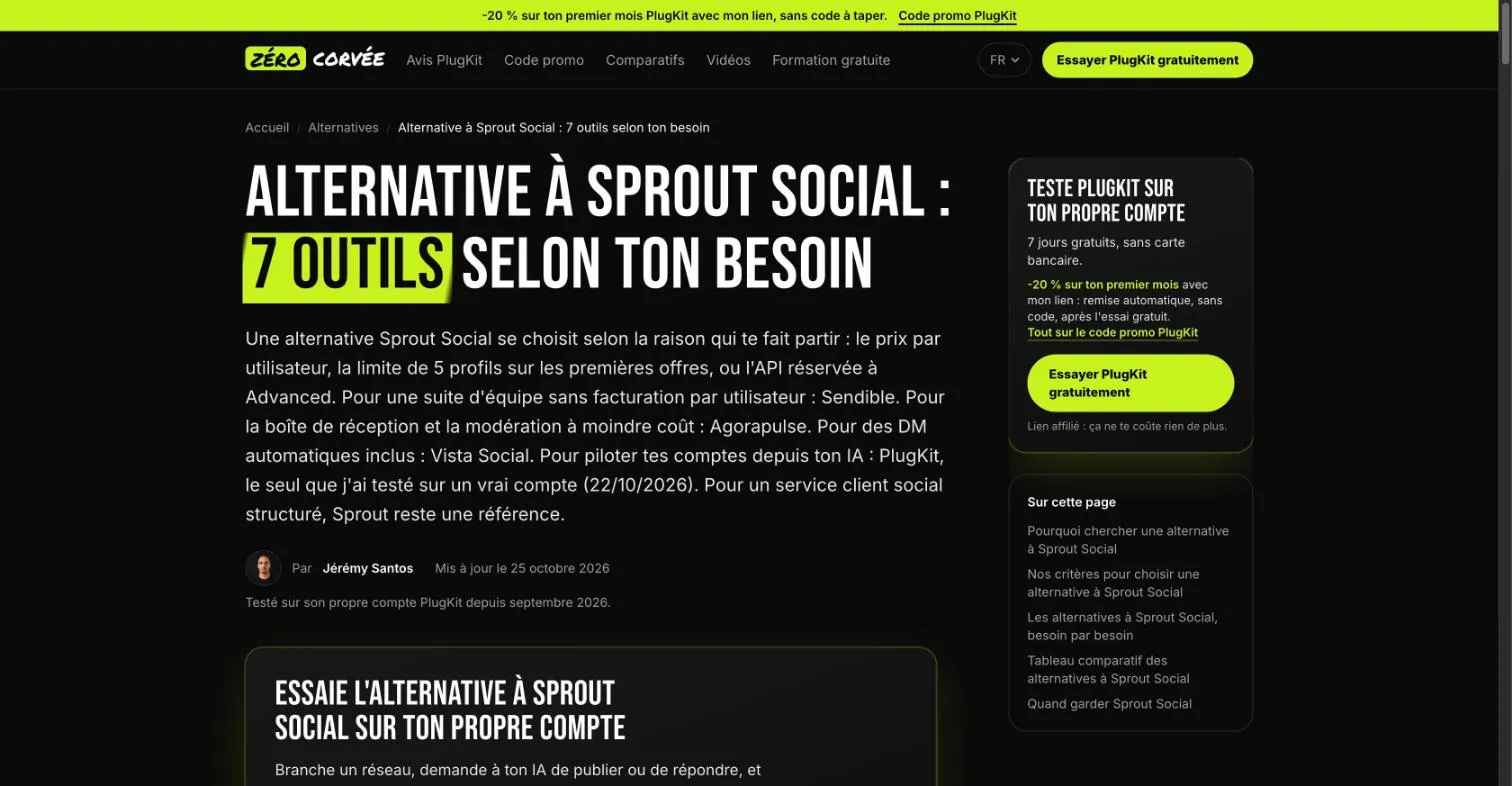
The fourth topic, Sprout Social versus Hootsuite, was already covered. My sitemap listed 3 Sprout Social pages, including an alternatives page that mentions Hootsuite 14 times (pages opened on October 29, 2026).
The habit to build: before you write, open your sitemap, the list of pages your site declares to Google, and search for the topic’s name.
A search volume far below other sources
For “Zoho Social,” SemChat gave 40 searches a month. Google Ads, pulled through DataForSEO, gave 320 (France, French, October 29, 2026). Eight times more. A volume from SemChat gets checked before you decide to write, or to skip a topic.
The Competitors tab that lists vendors, not Google rivals
Back to that tab. It shows an “Ajouter un concurrent” (add a competitor) button. Use it: replace the vendors with the sites that actually rank ahead of you, so the next analysis starts from the right rivals.
Cost of the request: 6.4 points of the Starter plan’s monthly quota, from 30% to 36.4% (October 29, 2026).
Social media competitor analysis: a different job
Comparing followers, posts and engagement on Instagram or LinkedIn is another kind of competitor analysis. It answers a different question (who wins attention on social platforms), with different tools. This page sticks to search: who ranks ahead of you in Google, and why. No social media tool is named here without its own page having been read.
What to do with your topics next
Once you’ve kept a few topics, put them in a plan: our guide on how to create an SEO strategy covers that. If your rivals are businesses in your own town, the game changes: see the local SEO tool page. Brand-new site? Start with SEO for a new website. And once a page is live, Google still has to find it: that’s what a URL indexer is for.
The full test of SemChat is in our SemChat review, and its plans are on our SemChat pricing page.
My verdict on SemChat among competitor analysis SEO tools: real topics with real addresses, as long as you name your Google rivals yourself. Its own check doesn’t replace yours: one topic was already on my site, and one volume was eight times too low. Name the rivals, demand the addresses, then open your sitemap.
Frequently asked questions
Which competitor analysis tool suits a small business?
One that compares you with the sites ranking ahead of you in Google, gives the real address of their pages, and lets you check its claims. This site has only tested SemChat on that job, so it doesn't rank tools. Whatever you pick, Google says it “doesn't evaluate or endorse third-party SEO tools” (read October 30, 2026).
Is there a free competitor keyword research tool?
Several tools have a free tier, with limits. Semrush's Free plan gives 10 reports a day, Seobility's free Basic plan tracks 3 competitors, and SemChat's Free plan at €0 includes every feature. Ahrefs says “you can't research competitors' sites without paying.” Limits come from each tool's own pages, read October 29 and 30, 2026.
How do you check a competitor's website?
Search your main keyword in Google and note who ranks ahead of you. Open their pages on the topics you're missing, and look at the sitemap of your own site to confirm you really don't cover them. A tool speeds this up, but check every topic it suggests before you write.
How much does SemChat's competitor analysis cost?
The skill is included in the Free plan at €0; the pricing page says “Every feature, in every plan.” (read October 30, 2026). In my test, one request used 6.4 points of the Starter plan's monthly quota, from 30% to 36.4% (October 29, 2026). Starter costs €20 a month.
Let your AI do the chores of getting found online.
10% off your subscription, for life with my link, if you subscribe within 2 weeks of signing up. No code. All about the SemChat promo code
Affiliate link: it costs you nothing extra.
Verified sources
- Google Search Central: Do you need an SEO? (30/10/2026)
- SpyFu home page (30/10/2026)
- SemChat pricing (Free plan, every feature in every plan) (30/10/2026)