SEO meaning: the simple answer, no jargon
SEO meaning, in one line: SEO stands for search engine optimization, the work that helps Google understand your website and show it to people who search for what you offer. It costs nothing to appear in Google's organic results, and nobody can buy a better organic spot. What it takes is time, or someone else's time.
 By Jérémy Santos Updated on October 30, 2026 Tested on his own SemChat account: first audit on October 29, 2026.
This page is part of the guide: SEO for small business
- 1 Someone searches "plumber open on Sunday"
- 2 Google sorts the pages it has already read and stored
- 3 Your page shows up if it answers the question best
You hear “SEO” everywhere, and nobody ever explained it simply. Here’s the short answer, then what it means for a shop or a small business, with no course and no jargon. It’s the first piece of our guide to SEO for small business.
The SemChat links on this page are affiliate links: if you subscribe through them, I earn a commission, at no extra cost to you and with no effect on what I write.
What is SEO? SEO meaning and definition in two sentences
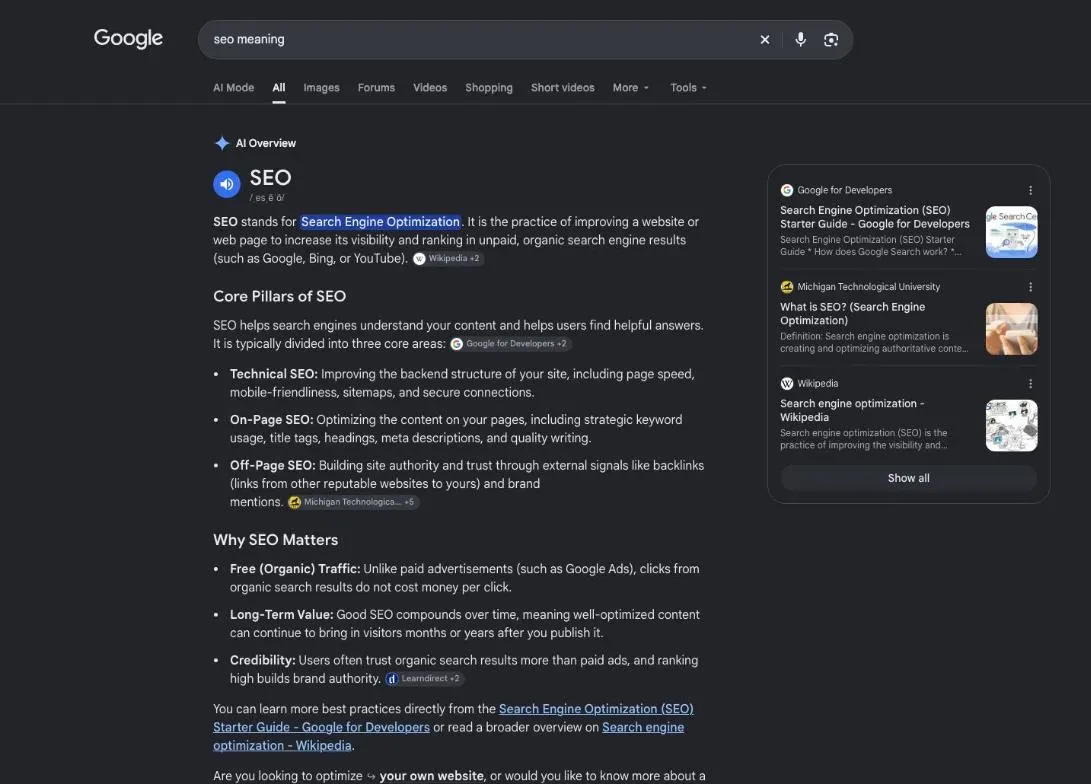
SEO is the work that helps Google understand your website, so it can show it to the right people. Google’s own definition: SEO “is about helping search engines understand your content, and helping users find your site and make a decision about whether they should visit your site through a search engine” (SEO Starter Guide, read October 30, 2026).
Search engine optimization meaning, word by word
- Search engine: Google, Bing and the like.
- Optimization: making something work better.
- Put together: making your site work better for search engines, and for the people who use them.
What does SEO mean, and what does SEM mean?
| SEO | Paid search | |
|---|---|---|
| Where it shows | organic results | ads marked Sponsored |
| What you pay | your time | each click |
| When you stop | your pages stay | you disappear |
SEM means search engine marketing. People use it mostly for paid search: ads on Google, billed per click. Some include SEO in it too. The useful line to draw is between results you earn and results you pay for.
SEO or paid ads: don’t mix them up
Ads don’t buy you an organic spot. Google is clear: “Google doesn’t accept payment to crawl a site more frequently, or rank it higher” (How Search works, read October 30, 2026). Ads appear in their own space, labeled “Sponsored”, and stop when your budget stops. Prices for both are on the SEO cost page.
SEO explained with a shop example
Take a bakery. A customer types “gluten free bread near me”. For the bakery to show up:
- Google must know its site and its Business Profile.
- A page or the profile must clearly say “gluten free bread”, with the address and hours.
- Reviews and a few links from local sites show that the bakery exists outside its own site.
That’s SEO: nothing magic, just making it easy for Google to match the bakery with that search.
How SEO works, in short
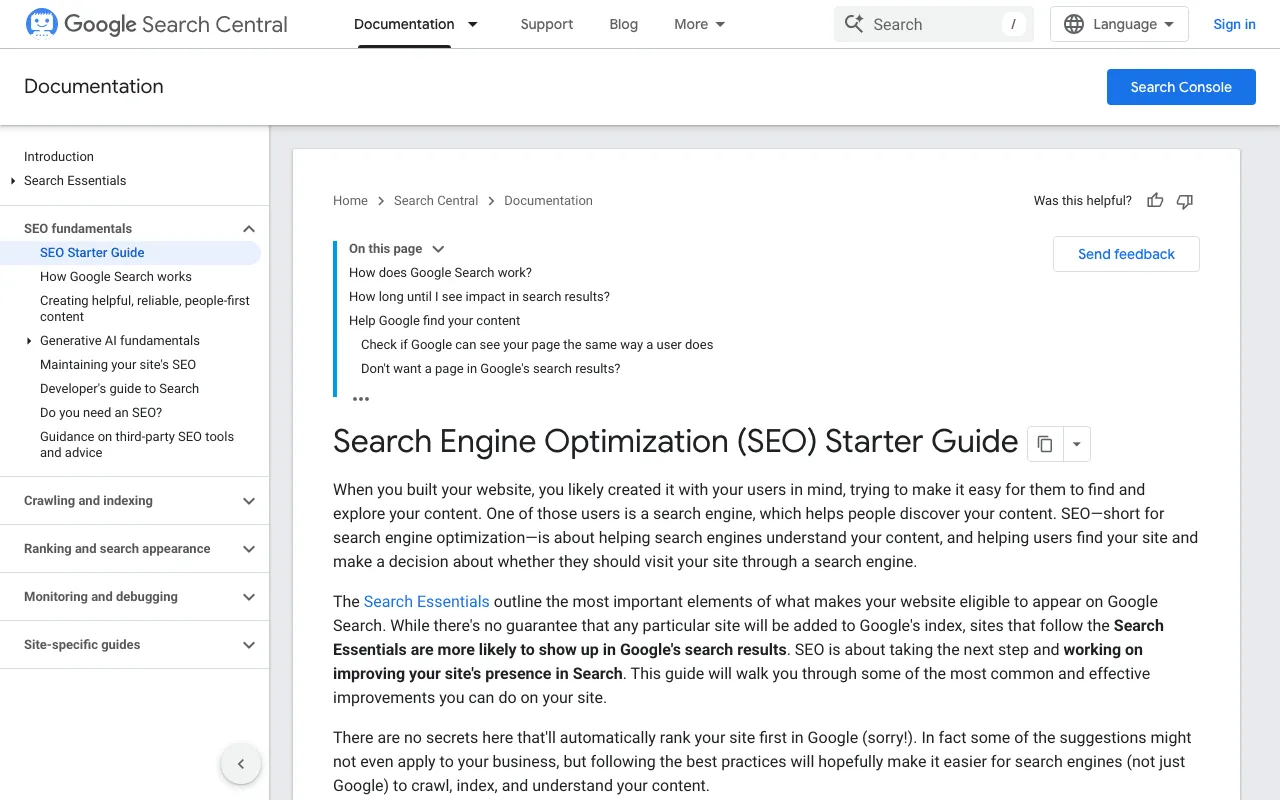
Google’s SEO Starter Guide. Screenshot of developers.google.com/search/docs/fundamentals/seo-starter-guide, taken October 30, 2026.
In Google’s words: “Google Search works in three stages, and not all pages make it through each stage”: crawling, indexing and serving search results. It also warns: “Google doesn’t guarantee that it will crawl, index, or serve your page” (How Search works, read October 30, 2026). To decide the order, Google weighs many factors, including the user’s location, language and device.
The main types of SEO, one line each
| What it covers | Your question | |
|---|---|---|
| Technical | can Google read your pages | are my pages indexed? |
| On-page | titles, text, images | does each page answer one search? |
| Links | other sites pointing to you | does anyone mention me? |
| Local | Business Profile, reviews | do I show up on Maps? |
Why SEO matters for your business
Because customers search before they call. SEO puts you in their path at the moment they need you, without paying for each visit. For a shop, it often starts with the Business Profile; for a freelancer, with one clear page per service.
SEO meaning in marketing
In marketing, SEO is one channel among others, next to ads, email and social media. Its trait: it builds slowly, and keeps bringing visits while your pages stay useful.
SEO on YouTube and social media: same word, other rules
People also say “YouTube SEO” or “Instagram SEO”: making a video or a post easier to find inside that platform’s own search. Same idea, different rules, set by each platform. This page is about Google.
SEO as a job title: who you would hire
“An SEO” can also mean a person. Google describes them this way: “SEOs (search engine optimizers) are professionals who can help you improve your website and increase visibility on search engines” (How to get your website on Google, read October 30, 2026). And it warns: “No one can guarantee a #1 ranking on Google. Beware of SEOs that claim to guarantee rankings” (Do you need an SEO?, same date).
SEO explained: the words you’ll hear, in plain English
You don’t need the vocabulary to do SEO, but it helps to understand a quote or an article. Here are the words that come up most, one short answer each.
Crawling
Google’s robot, Googlebot, visits pages and reads them. It finds most of them by following links from pages it already knows. A page no link points to is hard for it to find.
Indexing
After reading a page, Google decides whether to store it in its index, a huge catalog of pages. A page that isn’t indexed can’t show up in results, however good it is. Search Console tells you which of your pages are indexed.
Keyword
The words someone types into Google. “Dentist open Saturday” is a keyword. You pick one main keyword per page and write the page to answer it.
Ranking, or position
Where your page appears for a given search: first, fifth, on page three. Your position changes from one search to another, and from one person to another, since Google takes into account location, language and device.
Organic results and paid results
Organic results are the ones Google ranks on its own, free to appear in. Paid results are ads, marked “Sponsored”. Paying for ads doesn’t move your organic position.
Title and meta description
The title is the blue line in the results, usually taken from your page’s title element. The meta description is the short text below it. Neither guarantees a ranking, but both decide whether people click. Both belong to what you set on the page itself, explained in what is on-page SEO.
Backlink
A link from another site to yours. Earned links help Google find you and show that others vouch for you. Bought links can break Google’s spam policies.
Sitemap
A file that lists the important pages of your site. Google says it isn’t required, but it helps on a large site or one that changes often. Most website builders create it for you.
Search Console
Google’s free tool for site owners. It shows which searches display your site, how often people click, which pages are indexed and which errors Google found.
Local SEO and Business Profile
Local SEO is about showing up for searches near you, often on the map. Your Business Profile is the free listing that appears there, with your hours, photos and reviews.
What SEO is not
A few ideas come up often and don’t hold:
- Not a one-time job. Your competitors change their pages, your customers search differently, your services evolve. SEO is a habit, not a project.
- Not something you buy from Google. Google doesn’t accept payment to rank a site higher. Ads are a separate, paid space.
- Not a guarantee. Google itself doesn’t guarantee that it will crawl, index or show a page, and it warns against anyone promising a #1 ranking.
- Not about stuffing words. Repeating a keyword everywhere doesn’t make a page more useful. Write for the person searching.
- Not a secret recipe. Google’s own guide says there are no secrets that will automatically rank a site first.
How long SEO takes
Longer than ads, and with no fixed delay. Google writes that some changes take effect in a few hours while others can take several months, and suggests waiting a few weeks before judging whether a change worked (SEO Starter Guide, read October 30, 2026). A new page can take from a few days to a few weeks to be crawled, and requesting indexing doesn’t guarantee it will be included at all (Ask Google to recrawl your URLs, same date).
So plan in months, not days. Note your numbers in Search Console once a month, change one thing at a time, and compare.
Common SEO mistakes beginners make

A first step, without jargon. Illustration by Zéro Corvée.
- Writing for Google instead of customers. Google asks for content that is helpful, reliable and people-first.
- Chasing word counts. Google says length alone doesn’t matter for ranking.
- Buying links. It can break Google’s spam policies.
- Judging after three days. Google suggests waiting a few weeks before judging a change.
What you can do yourself this week
Start by checking what Google sees. On October 29, 2026, I asked SemChat, an SEO assistant you talk to in plain language, to audit my site plugkit-avis.com. The audit ran in French, on a French site with English versions. About 3 minutes later, I had a 5-point diagnosis.
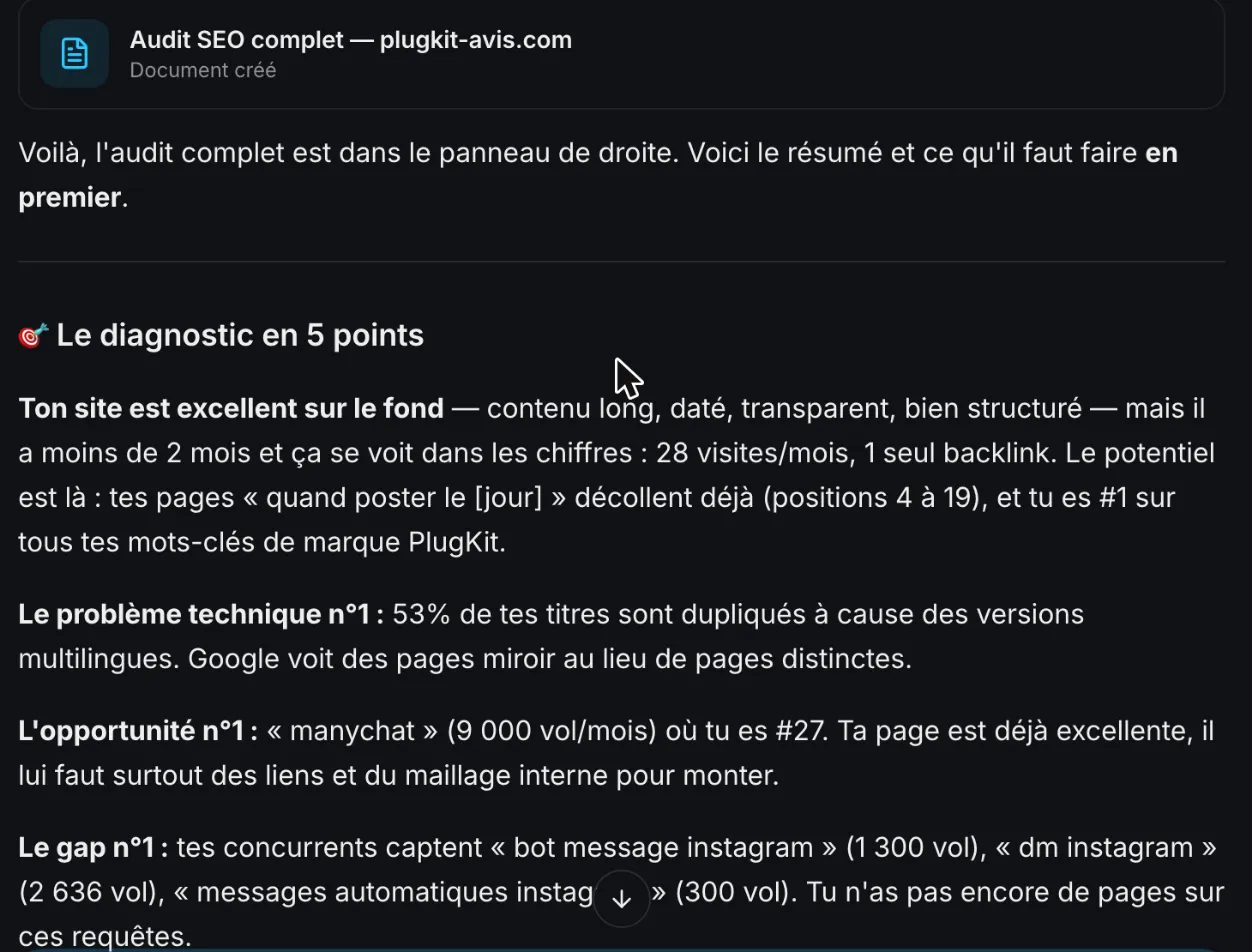
The diagnosis SemChat returned at the end of an SEO audit, October 29, 2026 (French interface). Screenshot of the SemChat app, Jérémy’s account, Free plan.
Two findings I checked by hand: the contact page returned a 404 error (true, it didn’t exist), and two English pages shared the same title, one for the United States and one for the United Kingdom. The nuance: those are declared language variants of one page, not copies. The full test is in my SemChat review.
Then pick your next read: search engine optimization explains the three levers in more depth, how to get my website on Google gives the steps, and how to get my website on Google for free lists the no-cost levers.
That’s the SEO meaning in practice: help Google read your site, answer real searches, earn mentions elsewhere. Start with the first one this week.
Frequently asked questions
Is SEO paid or free?
Free at Google: it costs nothing to appear in organic search results, and Google doesn't accept payment to rank a site higher (Google Search Central, read October 30, 2026). You pay with your time, or by hiring someone, and sometimes for a tool.
What are some effective SEO techniques?
Make sure Google can read and index your pages, give each page a clear title that matches one search, answer that search in the first lines, link your pages to each other, and earn links and reviews honestly. Google adds that there are no secrets that will automatically rank a site first.
What does on-page SEO mean?
Everything on the page itself: the title, the description, the headings, the text, the images and their descriptions, and the links to your other pages. It's the part you fully control.
What do SEO keywords mean?
The words people type into Google. A keyword for a bakery might be 'gluten free bread near me'. You pick one main search per page and write the page to answer it.
Let your AI do the chores of getting found online.
10% off your subscription, for life with my link, if you subscribe within 2 weeks of signing up. No code. All about the SemChat promo code
Affiliate link: it costs you nothing extra.
Verified sources
- Google Search Central: SEO Starter Guide (October 30, 2026)
- Google Search Central: In-depth guide to how Google Search works (October 30, 2026)
- Google Search Central: How to get your website on Google (October 30, 2026)
- Google Search Central: Do you need an SEO? (October 30, 2026)
- Google Search Central: Ask Google to recrawl your URLs (October 30, 2026)