How to get to the top of Google search: the honest method
How to get to the top of Google search, honestly: nobody can guarantee the #1 spot, and Google doesn't sell it. What works is picking a search you can actually win, building one page that answers it better than what's there, making sure Google can read your site, and earning links and reviews. Then you track your position and keep the page fresh.

 By Jérémy Santos Updated on 30 October 2026 Tested on his own SemChat account: first audit on 29 October 2026.
This page is part of the guide: SEO for small business
You want your business at the top when customers search. Fair goal. But “the top of Google” isn’t one place: it depends on the search. This page shows the honest method, with no ranking promise. It’s part of our guide to SEO for small business.
The SemChat links on this page are affiliate links: if you subscribe through them, I earn a commission, at no extra cost to you and with no effect on what I write.
How to get to the top of Google search: pick which search first
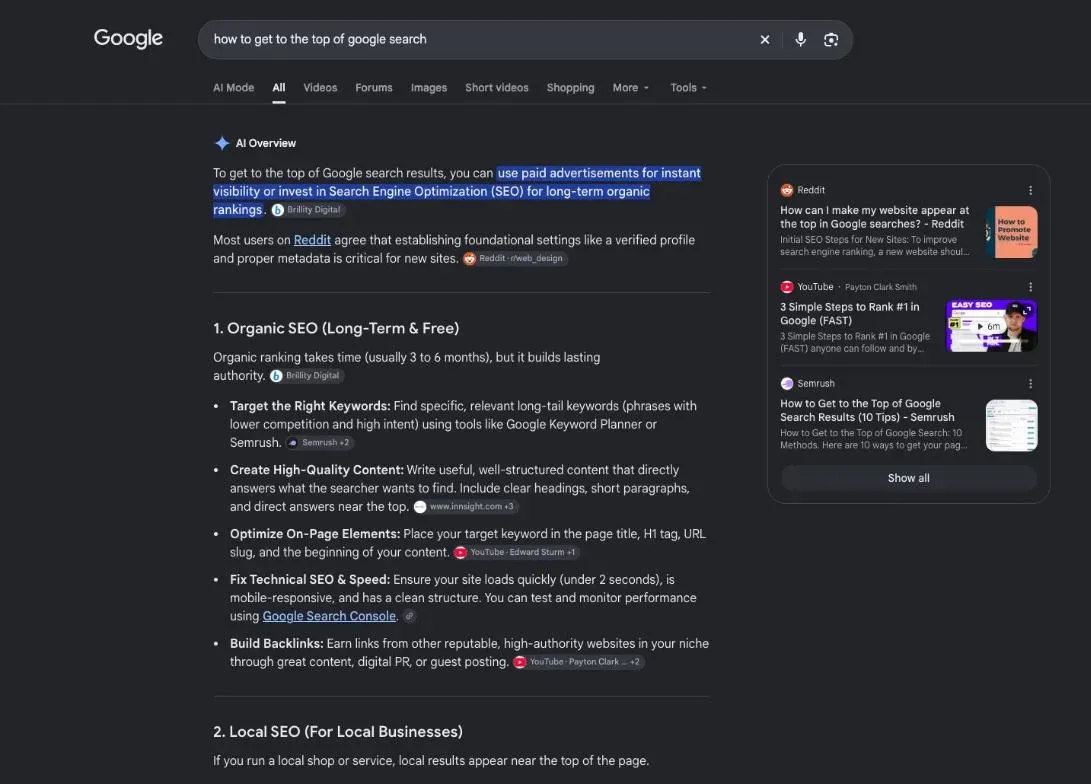
You don’t rank “on Google”. You rank on one search. “Plumber” in a big city, “emergency plumber open Sunday in Dayton” and your business name are three different fights. Start by choosing the one that matters and that you can win.
First result or first page: not the same goal
The first spot is one of several organic results on page one. Aim for page one first, then climb. And distrust anyone who promises more. In Google’s words: “No one can guarantee a #1 ranking on Google. Beware of SEOs that claim to guarantee rankings” (Do you need an SEO?, read 30 October 2026).
Organic results, local results and ads
A results page can show ads, a map with local businesses, and organic results. Ads are a paid space, labelled “Sponsored”, and they don’t buy an organic spot: “Google doesn’t accept payment to crawl a site more frequently, or rank it higher” (How Search works, read 30 October 2026). Their price is on the SEO cost page.
Pick a search you can actually win
The best target is precise, close to what you sell, and not owned by national brands. “Gluten free birthday cake in Austin” is easier than “cake”. Fewer people search for it, but the ones who do are ready to buy.
Look at who is already at the top
Type your search and open the top results. If they’re all national chains or big media sites, pick a more precise search. If they’re small local sites, thin pages or old articles, you have a chance.
One page for one search intent
| The page that answers | What the person wants | |
|---|---|---|
| water heater replacement | your water heater page | the service, near them |
| plumber prices | your pricing page | a price before calling |
| your business name | your home page | your contact details |
Two pages that target the same search compete with each other. Give each search its own page, and each page its own search.
The title and description Google shows
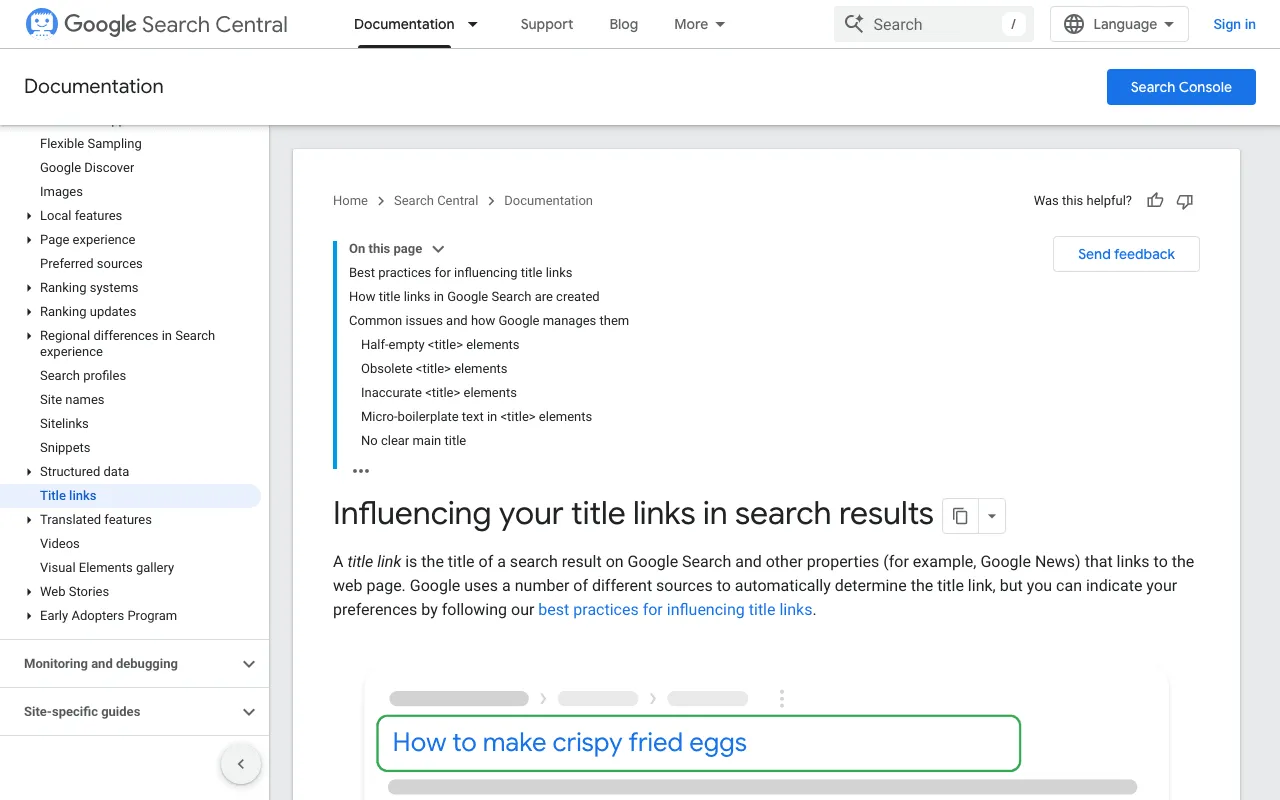
Google’s documentation on title links. Screenshot of developers.google.com/search/docs/appearance/title-link, taken 30 October 2026.
The blue title in the results is often the page’s title element, but not always: “Google uses a number of different sources to automatically determine the title link”. Its advice: “Make sure every page on your site has a title specified in the <title> element” (page read 30 October 2026). Put the search at the start, then a reason to click.
Content that beats what is already there
Read the top results and ask: what do they miss? Prices, photos of your work, a clear answer in the first lines, a short FAQ? Do better on what matters to your customers. Google is clear that the length of the content alone doesn’t matter for ranking (SEO Starter Guide, read 30 October 2026).
A site Google can read quickly
Speed and stability count, but they’re not the whole story. Google writes that “Core Web Vitals are used by our ranking systems”, and that good scores don’t guarantee that your pages will rank at the top (Understanding page experience, read 30 October 2026). Check that your site works on a phone, loads without long waits, and runs on HTTPS. Then go back to content.
Links from other sites: the slowest lever
Links from other sites help Google find you and show that others vouch for you. They take time: ask your trade association, partners, suppliers, local press. Never buy them: Google writes “please don’t pay them to link to you; that could be considered a violation of Google’s spam policies” (How to get your website on Google, read 30 October 2026).
Reaching the top without backlinks: when it happens
On very precise searches with weak competition, a page can rank well with few or no links, because it answers best. How often that happens: missing data (planned source: a dated study of rankings on low-competition searches). Don’t plan around it; plan around the page.
The top of the local results: Google Maps
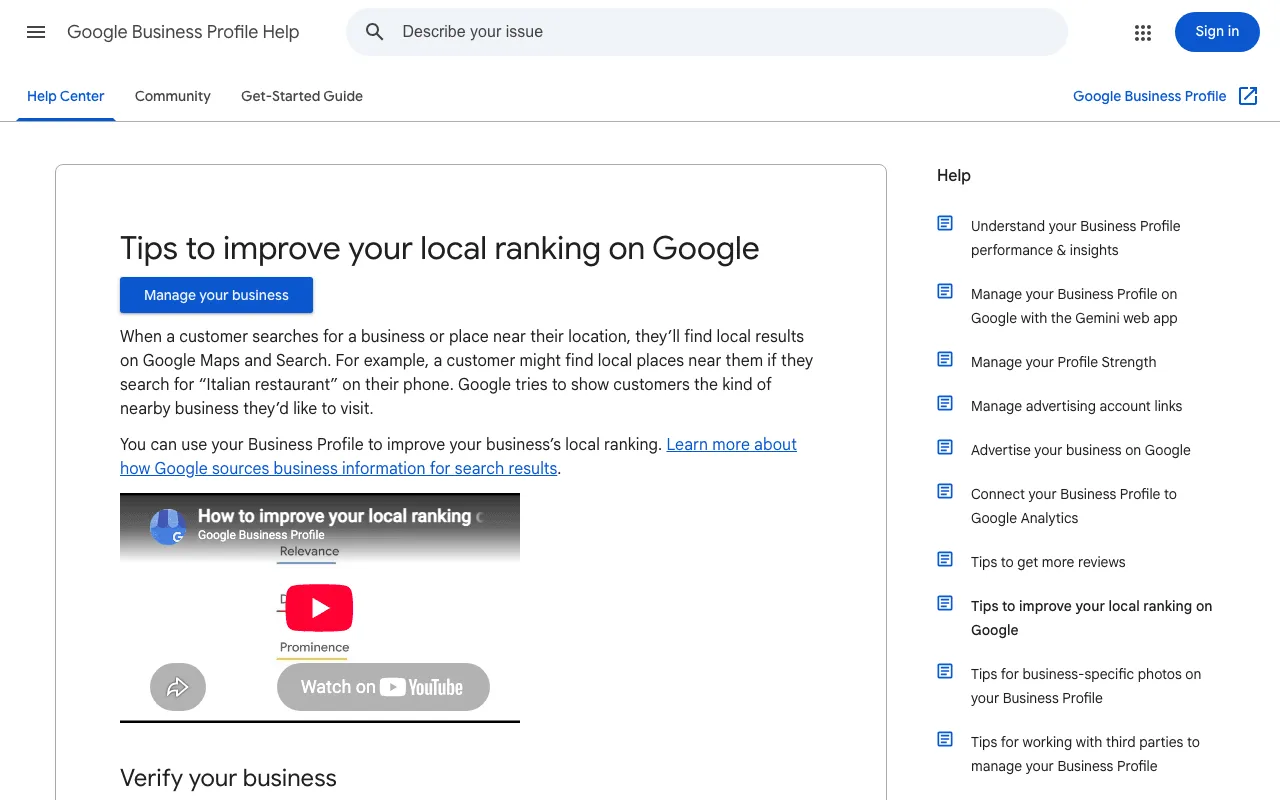
Google’s help page on local ranking. Screenshot of support.google.com/business/answer/7091, taken 30 October 2026.
For “near me” searches, the map often comes first. Google says: “Local results are mainly based on relevance, distance, and popularity”, and “There’s no way to request or pay for a better local ranking on Google” (Business Profile help, read 30 October 2026). You can’t change your distance; you can complete your profile, keep your hours right, and earn genuine reviews.
A 30-day plan to climb on one search
- Days 1 to 3: pick the search. One precise search close to what you sell, with small sites in the top results.
- Days 4 to 10: build or rebuild the page. A title that starts with the search, the answer in the first lines, prices or area, photos, a short FAQ, a way to reach you.
- Days 11 to 14: connect it. Link it from your home page and two or three related pages, with words that describe it.
- Days 15 to 25: earn two or three mentions. A partner, a supplier, your trade association; and reviews from real customers if it’s a local search.
- Day 30: measure. Note the page’s position and clicks in Search Console. Then wait: Google suggests a few weeks before judging a change.
Track your position and keep it
Before you write, see where you stand. On 29 October 2026, SemChat’s audit of my site plugkit-avis.com (Haloscan data, France) returned 89 ranking rows, filterable and exportable as CSV: 61 keywords, about ten of them in positions 1 to 3.
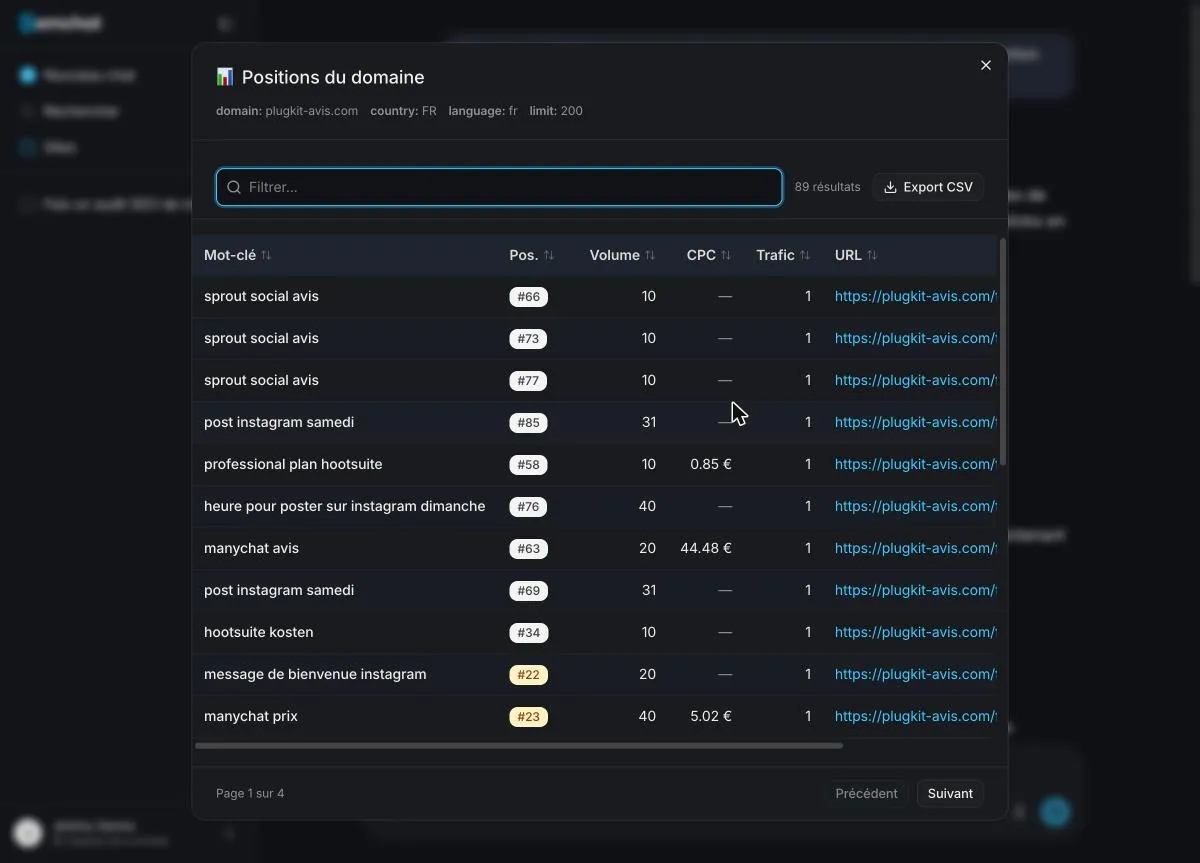
A site’s rankings by search query in SemChat, 29 October 2026 (French interface). Screenshot of the SemChat app, Jérémy’s account, Free plan.
The same audit flagged an opportunity: a search with 9,000 monthly searches according to SemChat, where one of my pages sat at position 27. That’s the ideal target: a page that exists, far enough to have room, close enough to climb. Two limits. These are French positions from Haloscan; for a US site, SemChat uses a mix of providers it doesn’t name (email from Adrian Delmarre, 29 October 2026), and their quality: missing data (planned source: a supervised test on a US site). And that single audit used up the Free plan’s monthly quota. More in my SemChat review.
How often to update a page that ranks
Reread your main pages every quarter: prices, photos, services you no longer offer. Google suggests waiting a few weeks after a change before judging it. Change one thing at a time, so you know what worked.
Related reads: how to get my website on Google if your pages aren’t indexed yet; how to improve SEO for the order of fixes; how to get my website on Google for free for no-cost levers; SEO meaning and search engine optimisation for the basics.
How to get to the top of Google search, in one line: pick a search you can win, build the best page for it, let Google read it, earn links, and track your position. No shortcut, no guarantee, but a method that holds.
Frequently asked questions
How do you get higher up on Google Search?
Find pages that already rank between positions 5 and 30 in Search Console, improve their title and content so they answer the search better, link to them from your other pages, and earn a few links from other sites. Then wait a few weeks and compare.
Where should a beginner start learning SEO?
With Google's free SEO Starter Guide, written for site owners, and with your own Search Console: it shows the searches your site already appears for. Learn by fixing one page at a time.
How can you get on Google's first page for free?
Organic results are free: Google doesn't accept payment to rank a site higher (Google Search Central, read 30 October 2026). Pick a precise search with little competition, write the best page for it, and make sure Google can index it.
Can someone guarantee me the #1 spot?
No. Google writes: 'No one can guarantee a #1 ranking on Google. Beware of SEOs that claim to guarantee rankings' (Do you need an SEO?, read 30 October 2026).
Let your AI do the chores of getting found online.
10% off your subscription, for life with my link, if you subscribe within 2 weeks of signing up. No code. All about the SemChat promo code
Affiliate link: it costs you nothing extra.
Verified sources
- Google Search Central: Do you need an SEO? (October 30, 2026)
- Google Search Central: In-depth guide to how Google Search works (October 30, 2026)
- Google Search Central: Influencing your title links (October 30, 2026)
- Google Search Central: SEO Starter Guide (October 30, 2026)
- Google Search Central: Understanding page experience (October 30, 2026)
- Google Search Central: How to get your website on Google (October 30, 2026)
- Google Business Profile Help: tips to improve your local ranking (October 30, 2026)