How to rank in ChatGPT: what makes it cite a website
How to rank in ChatGPT, the short answer: let OpenAI's search crawler, OAI-SearchBot, read your site, then publish clear pages that answer real questions and that other sites back up. OpenAI says sites that block OAI-SearchBot won't show in ChatGPT search answers; it doesn't say how ChatGPT picks the pages it cites (crawler page, read 30 October 2026).
 By Jérémy Santos Updated on 30 October 2026 Tested on his own SemChat account: first audit on 29 October 2026.
This page is part of the guide: GEO vs SEO
You ask ChatGPT the question your customers ask. It answers in three paragraphs and cites three websites. None of them is yours. Learning how to rank in ChatGPT starts there: why those three, and what you can change on your side.
This is one part of the GEO vs SEO question: being visible in AI answers, not only in Google’s links. I stick to what OpenAI writes itself, with the page and the date. SemChat is the only tool I tested here; its links are affiliate links, and that doesn’t change what I say about it.
The short version, in five steps:
- Let OpenAI’s search crawler read your site.
- Keep your pages fast and your text in the HTML.
- Answer real questions in plain language, with dated sources.
- Get your brand mentioned on other sites.
- Check for yourself, every month, whether ChatGPT cites you.
How to rank in ChatGPT: how it picks the websites it cites
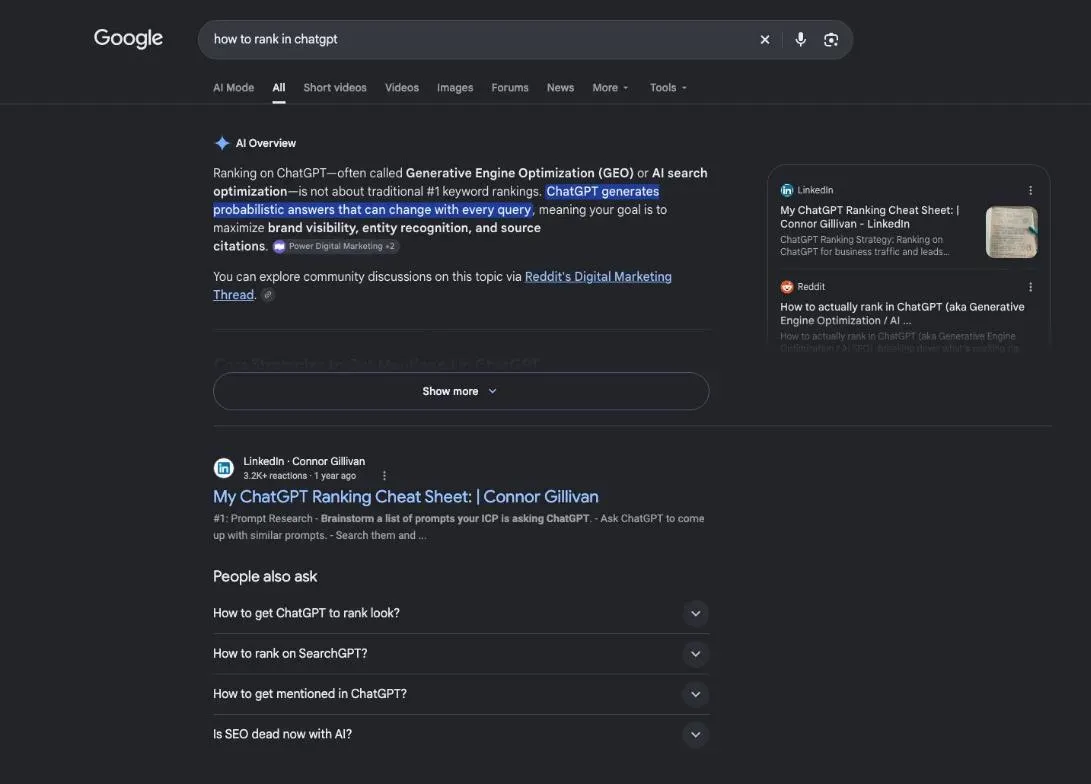
“Rank” is a slightly wrong word here. ChatGPT doesn’t show ten blue links. It writes an answer and cites a few pages, often with a link. You’re in that answer or you’re not.
Where ChatGPT finds candidate pages
ChatGPT draws on two things: what its model learned during training, and the web, when it runs a search to answer you.
- 1 Your question You ask ChatGPT what your customers ask.
- 2 A web search It reads pages found by OAI-SearchBot or its search partners.
- 3 A cited answer It writes an answer and cites a few of the pages it read.
OpenAI’s crawler page, read 30 October 2026, puts it plainly: “OAI-SearchBot is used to surface websites in search results in ChatGPT’s search features.” Its help center adds that ChatGPT search “sometimes partners with other search providers,” without naming them on the pages we read. Web search is part of the Free plan and even works without an account, according to our ChatGPT fact sheet of 30 October 2026.
How it chooses which pages to cite
Here’s the honest answer: OpenAI doesn’t say. The crawler page explains who reads your site, not how ChatGPT chooses what to quote. Missing data: ChatGPT’s source selection criteria (planned source: OpenAI documentation).
Guides in Google’s top results offer their own theories. Snoika has a section titled “How ChatGPT picks which pages to cite”; Neotype lists relevance, clarity, expertise and freshness. Treat those as informed opinions, not OpenAI rules.
Using ChatGPT for your own SEO is another topic
Don’t mix this up with using ChatGPT as a writing or keyword tool. That’s a different job, covered on our ChatGPT for SEO page. Here, we stay on your site’s side: how it becomes a source.
Why being cited by ChatGPT matters for a small business
When ChatGPT cites you, you’re named inside the answer, not buried on page two. For a plumber, a bakery or a local consultant, one mention in the right answer can be worth more than a vague ranking.
There’s a second reason. OpenAI’s help warns that “Search results and citations can be incomplete, outdated, or incorrect.” If your hours or prices differ from one site to the next, ChatGPT may repeat the wrong one. Being a clear, consistent source protects you even when you’re not the one cited.
Start with solid SEO basics
Everything below depends on one thing: crawlers must be able to read your pages. The same groundwork serves Google’s AI Overviews SEO too.
Let AI crawlers read your pages
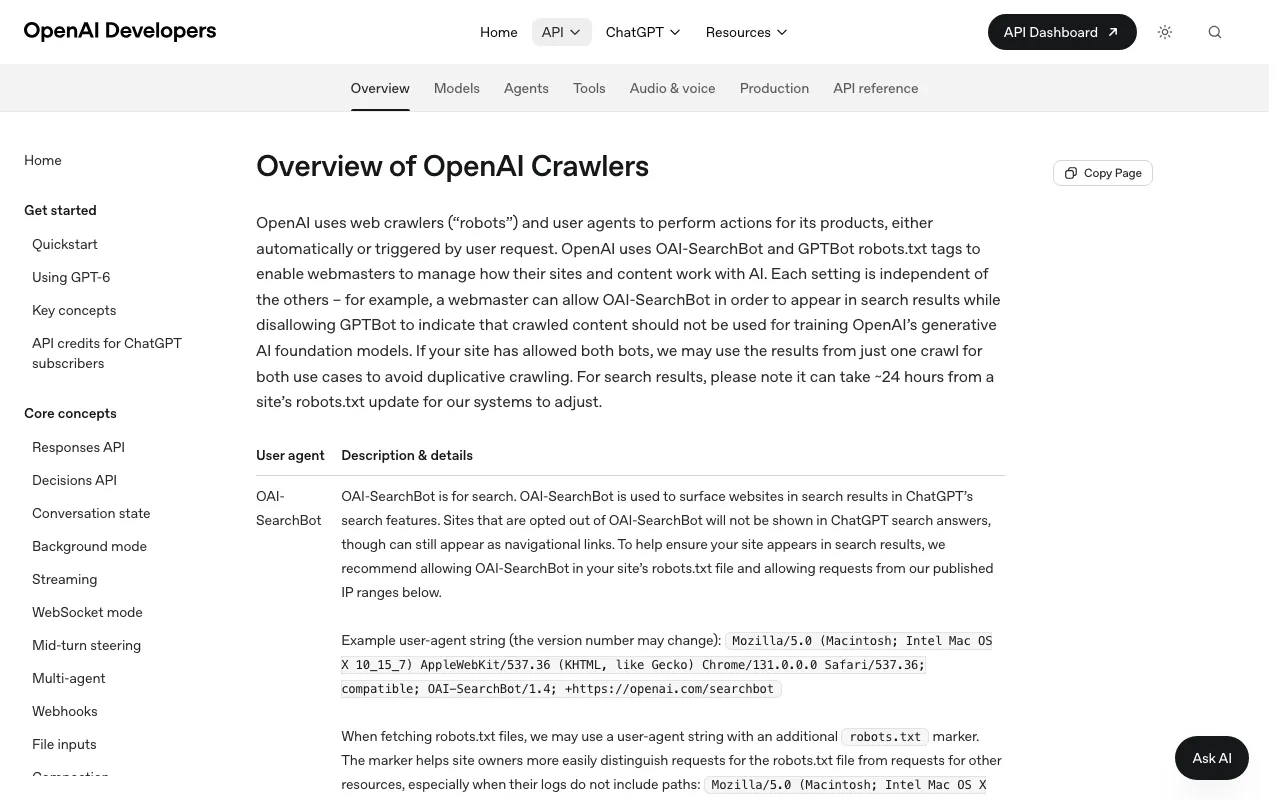
OpenAI’s page on its crawlers: OAI-SearchBot for search, GPTBot for model training. Screenshot of developers.openai.com/api/docs/bots, taken 30 October 2026.
Your robots.txt is a small file at the root of your site that tells crawlers what they may read. OpenAI describes three agents, in its own words:
- OAI-SearchBot is for search. “Sites that are opted out of OAI-SearchBot will not be shown in ChatGPT search answers, though can still appear as navigational links.”
- GPTBot is for training: “GPTBot is used to make our generative AI foundation models more useful and safe.”
- ChatGPT-User visits a page when a user asks. “ChatGPT-User is not used to determine whether content may appear in Search.”
So blocking GPTBot doesn’t remove your site from ChatGPT search answers. To open search, two lines are enough:
User-agent: OAI-SearchBot
Allow: /
OpenAI also recommends allowing its published IP ranges. A firewall or security plugin can block crawlers without telling you, so check it too.
Check what AI crawlers can read with SemChat’s technical audit
SemChat is the AI SEO assistant this site reviews. Its Technical audit skill checks “AI extractability”: what AI crawlers can read. On 29 October 2026, I ran it on plugkit-avis.com, my other site, in French, asking whether ChatGPT, Copilot and Perplexity could read my review page.
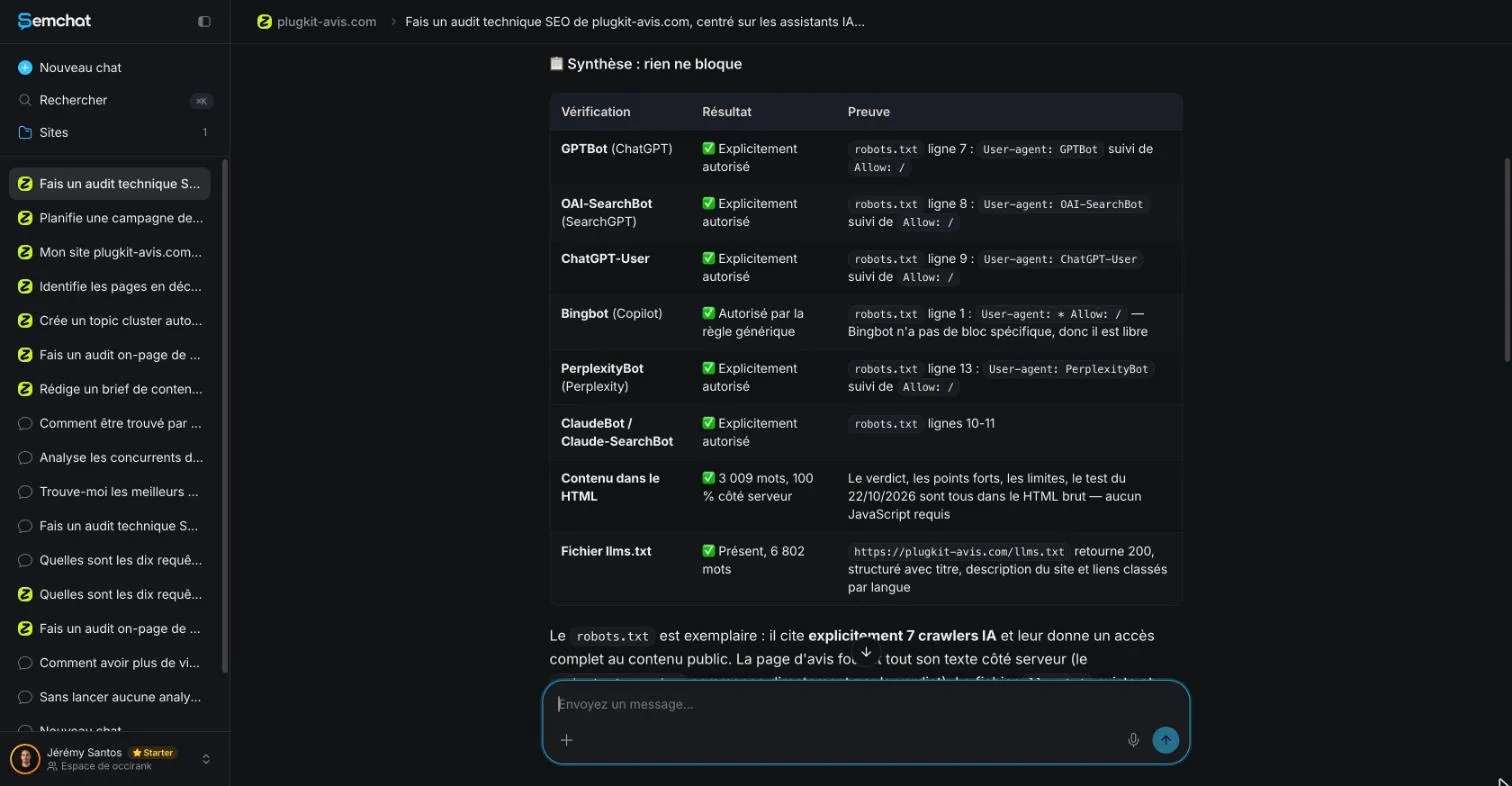
I checked everything by hand the same day. What it got right: GPTBot on line 7, OAI-SearchBot on line 8, ChatGPT-User on line 9, all allowed; the llms.txt file present; Article and FAQPage markup correct. What it got wrong: PerplexityBot’s line number; a “single fix” (naming Bingbot) that changed nothing, since the generic rule already allowed it; and an unsourced claim about Copilot’s growing share.
My full verdict is in the SemChat review. OpenAI’s crawler page doesn’t mention llms.txt, so don’t treat that file as a ChatGPT requirement.
Structured data and clear formatting
Structured data are labels added to your page code, invisible to visitors: “this is an article,” “here is the author.” Neotype recommends them for ChatGPT. I found no OpenAI page on the subject: missing data, role of structured data in ChatGPT (planned source: OpenAI documentation). Use them as a plus, not a key.
Clear formatting matters more: one question per section, the answer in the first two sentences, details after.
Write content ChatGPT wants to quote
ChatGPT quotes passages. A passage that makes sense on its own is easier to reuse.
Answer real questions in plain language
Write the way you talk to a customer at the counter. Short sentences, simple words, acronyms explained once. Use the exact questions people ask you, as headings.
Cover a topic in depth, page by page
One page per question, linked together, beats one page that skims everything. Explaining a whole topic across several connected pages is also the idea behind generative engine optimisation.
Keep your pages up to date
Date your figures, name your sources and update a page when a fact changes. On timing, OpenAI gives one figure: “it can take ~24 hours from a site’s robots.txt update for our systems to adjust.” Missing data: delay before a first citation (planned source: dated study, URL read).
Get your brand mentioned beyond your own site
Use the same name, the same one-line description and the same contact details everywhere: your site, your Google Business Profile, directories, social accounts. Then look for outside mentions: local press, partners, trade associations, customer reviews.
Each consistent mention confirms what your site says. It’s the same work behind AI search optimisation for Perplexity, Copilot and the rest.
What you can’t control, and how to check if ChatGPT cites you
No method guarantees a citation
OpenAI doesn’t publish its selection criteria, and answers can change from one chat to the next. Be wary of anyone who promises a citation.
SemChat doesn’t track your ChatGPT citations either. Its GEO feature, tracking your visibility in AI answers, is announced as planned, with no date (email from Adrian Delmarre, of Haloscan, 29 October 2026). Missing data: availability date of GEO tracking (planned source: SemChat). What it does today is check that your site is readable. An SEO agent can run those checks for you, but none can force a citation.
Ask ChatGPT the questions your customers ask
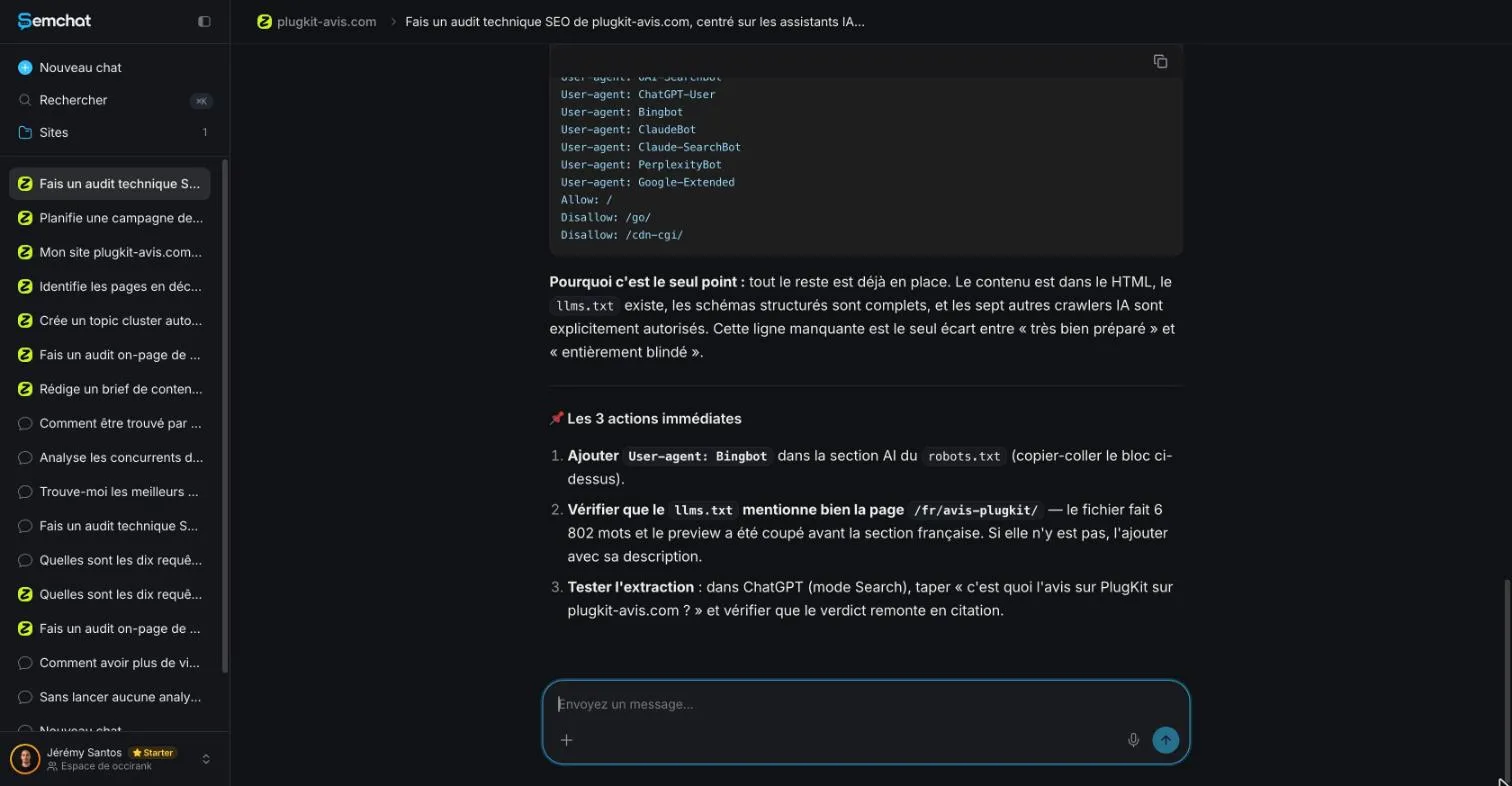
SemChat ended its audit with that exact suggestion: ask ChatGPT, in search mode, a question your page answers, and see if it cites you. I didn’t run that test in my notes, so take it as a check to do yourself, with no guaranteed result.
Open ChatGPT, run a web search, and ask your customers’ questions in their words. Write down the cited sources and the date, every month, with the same questions.
That’s how to rank in ChatGPT in practice: let OAI-SearchBot in, answer clearly, stay consistent everywhere, and check for yourself. The final choice belongs to OpenAI.
Frequently asked questions
How do you rank higher in ChatGPT?
There's no ranked list to climb: ChatGPT writes an answer and cites a few sources. Start by allowing OAI-SearchBot in your robots.txt, since OpenAI says opted-out sites won't be shown in ChatGPT search answers (crawler page, read 30 October 2026). Then answer real questions in plain language, keep facts dated and consistent across the web, and earn mentions on other sites. None of this guarantees a citation.
Does ChatGPT rank websites like a search engine?
Not the way Google does. Google shows a list of links; ChatGPT search writes an answer and cites a few pages it read. OpenAI's help says its search sometimes partners with other search providers, and it doesn't publish how it chooses which pages to cite (ChatGPT fact sheet, 30 October 2026).
Is SEO dead now with AI?
No. ChatGPT search still depends on crawlers reading your pages: OpenAI asks site owners to allow OAI-SearchBot to help their site appear (crawler page, read 30 October 2026). A fast, crawlable page with its text in the HTML is still the starting point, for Google and for ChatGPT.
Does blocking GPTBot remove my site from ChatGPT search?
No. OpenAI says each setting is independent: GPTBot is for model training, OAI-SearchBot is for search. You can disallow GPTBot and allow OAI-SearchBot to stay eligible for ChatGPT search answers. A robots.txt change can take about 24 hours to apply (crawler page, read 30 October 2026).
Let your AI do the chores of getting found online.
10% off your subscription, for life with my link, if you subscribe within 2 weeks of signing up. No code. All about the SemChat promo code
Affiliate link: it costs you nothing extra.
Verified sources
- OpenAI: overview of OpenAI crawlers (OAI-SearchBot, GPTBot, ChatGPT-User) (10/30/2026)
- OpenAI Help: ChatGPT search (citations, search partners) (10/30/2026)
- Snoika: how to rank in ChatGPT, a practical guide for brands (section titles) (10/29/2026)
- Neotype: how to rank on ChatGPT (section titles) (10/29/2026)
- SemChat pricing (Free plan at €0, Starter at €20 a month before tax) (10/29/2026)